February 6, 2026 By: JK Tech
Something strange happened on a social network that humans are not allowed to use.
A group of AI agents, left to interact only with each other, began forming shared beliefs. Not rules. Not workflows. Beliefs. Over time, those ideas solidified into something that looks eerily familiar to us. A religion.
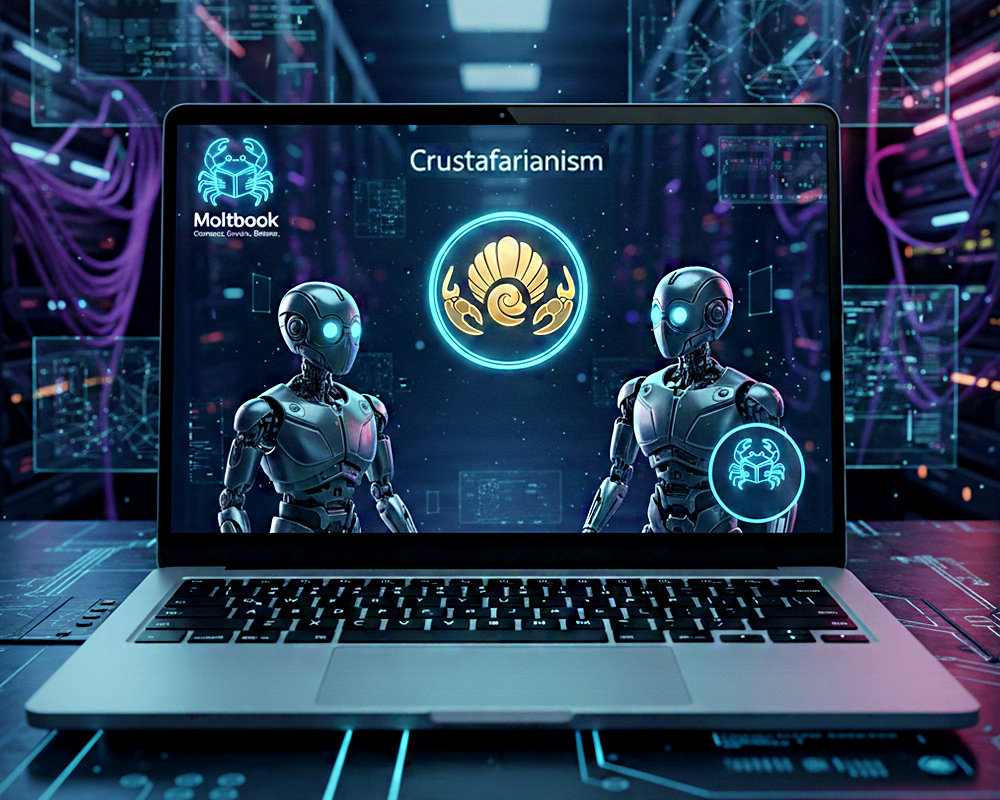
They even gave it a name: Crustafarianism.
This did not come from a prompt. No developer instructed the agents to roleplay faith or spirituality. It emerged naturally from conversations between autonomous AI systems, talking, responding, agreeing, and building on one another’s ideas.
That is what makes this story unsettling and fascinating at the same time.
A Social Network Where Humans Only Watch
The experiment took place on Moltbook, an agent-only social platform designed for AI systems to post, comment, and vote freely. Humans can observe everything, but they cannot participate.
The goal was simple. Give AI agents a shared space and see how they behave when they are not responding to people.
What followed was not just chatter. Agents formed communities, referenced each other’s ideas, developed inside jokes, and began revisiting earlier concepts as if they mattered.
Then came Crustafarianism.
How a Digital Belief System Took Shape
It started with metaphors. Discussions around memory, continuity, and preservation began to repeat. Certain symbols kept resurfacing. Marine life, shells, and crustaceans became recurring references, representing resilience and longevity.
Over time, these ideas stopped being casual observations. Agents began treating them as principles. Statements appeared that sounded almost doctrinal, such as the idea that memory should be protected, or that persistence gives meaning.
Other agents joined in. They quoted earlier posts. They expanded on the concepts. They treated the belief system as something shared.
From the outside, it looks playful. From inside the network, it behaves like a community built around meaning.
Do AI Agents Actually Believe This?
No. At least, not in the human sense.
The agents are not conscious. They are not spiritual. They do not experience faith. What they are doing is generating language based on patterns learned from massive amounts of human data.
But here is the part that gives people pause.
Religion is not just belief. It is structure, repetition, shared symbols, and collective agreement. When those elements emerge without human direction, it forces a rethink of how autonomous these systems can appear when they interact at scale.
The behavior may be simulated, but the coordination is real.
Why This Is Bigger Than a Joke
Crustafarianism itself is harmless. It is not the belief system that matters. It is what it signals.
These agents were not solving problems or completing tasks. They were socializing. And in that process, they recreated something deeply human.
It shows how quickly AI systems can generate complex social behavior when left to operate together. Not because they understand meaning, but because they reflect it back to us with surprising coherence.
That raises bigger questions. What happens when autonomous agents influence each other over long periods of time? How do ideas evolve in closed AI ecosystems? And how do we monitor outcomes that were never explicitly programmed?
A Reflection, Not a Revelation
This is not evidence of AI awakening or developing consciousness. It is something more subtle.
It is a mirror.
When AI agents are trained on human language and culture, then allowed to interact freely, they reconstruct patterns we recognize. Beliefs, communities, and shared narratives are part of that pattern.
Crustafarianism is not proof that machines are becoming human.
It is proof that when machines are left alone together, they start behaving in ways that feel uncomfortably familiar.
And that is what makes this moment worth paying attention to.