August 4, 2026 By: Sreenivasa Sunkari
I have spent the better part of two decades helping retail organizations close the gap between what customers expect and what their systems can actually deliver. Rarely has that gap been more visible, or more expensive to ignore, than it is today.
Here is the pattern I see in board after board, brand after brand: walk into a flagship store, and a knowledgeable associate reads the room and guides the sale. Open the same brand’s app at midnight, and you are handed to a chatbot that cannot locate your order. That inconsistency is not a minor UX flaw. It is retail’s most costly unsolved problem, and it sits squarely at the center of every omnichannel strategy conversation I have with clients and boards alike.
Multichannel shopping behavior is no longer a niche pattern; it is the default. Customers research on a phone, compare in a store, and complete the purchase wherever is most convenient, often within the same hour. Retailers that treat each of those moments as a separate channel, run by separate systems and separate teams, are structurally unable to deliver what the customer experiences as a single relationship. That structural gap, not a shortage of channels, is the problem I see costing retailers the most in lost loyalty and lifetime value.
Having evaluated this problem from both the technology and the P&L side, I have become convinced that digital humans represent one of the most viable bridges across that divide, provided leadership is honest about what the technology can and cannot yet do.
What do I mean by “Digital Human”?
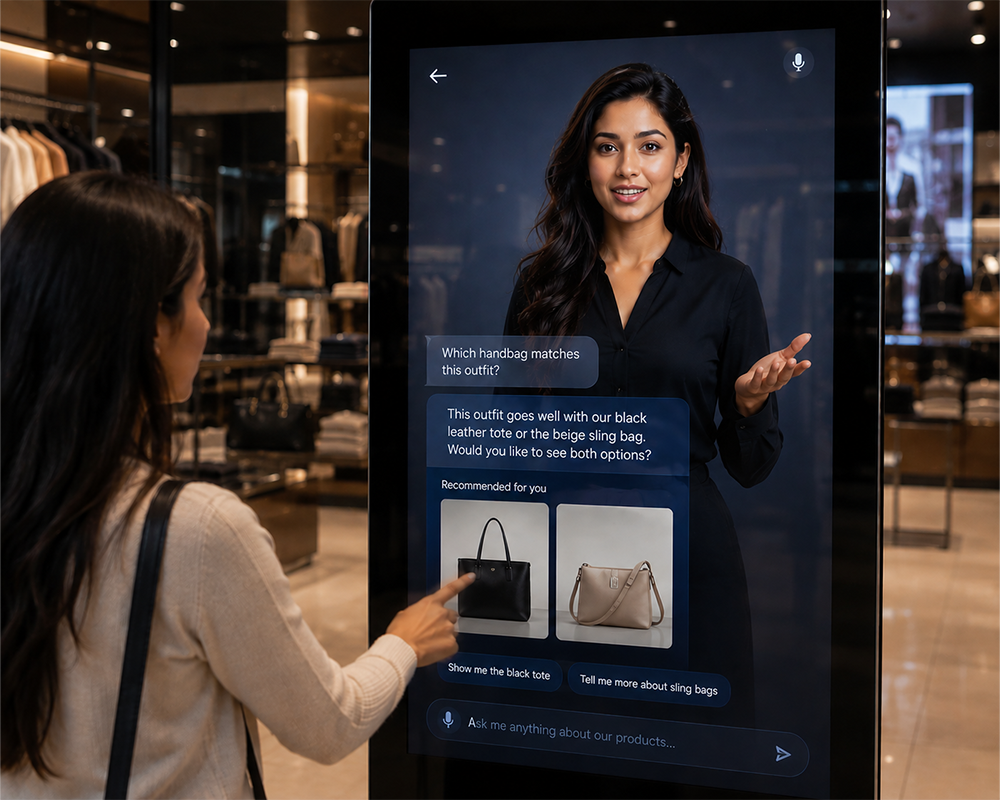
Let me be precise, because the term gets used loosely. A digital human is not a chatbot wearing a friendlier face. It is a realistic, AI-animated avatar that fuses large language models, voice synthesis, facial reenactment, and real-time sentiment analysis into a single conversational interface. Trained on a brand’s own data, it can field complex product questions, process returns and recommend complementary items- all while displaying facial expressions designed to read as more natural and less mechanical than a text box.
The technology has matured past the pilot stage. NVIDIA’s ACE platform and enterprise partners such as UneeQ are among the vendors now making lifelike digital humans deployable across kiosks, websites, mobile apps, and AR mirrors, often at a fraction of the marginal cost of scaling live staff to match demand at every hour and every channel.
That said, I want to be direct about something too many vendor decks gloss over: the research on whether customers actually prefer AI-driven avatars to human staff is far less settled than the industry’s marketing suggests. Independent consumer research over the past several years- from firms including SurveyMonkey, Retail Dive’s own consumer surveys, and others has repeatedly found that a clear majority of customers still say they’d rather deal with a human, particularly for anything beyond a simple, well-defined request. Some of that same research shows real openness to AI-assisted service when it is fast, well-designed, and doesn’t pretend to be something it isn’t.
I raise this not to undercut the case for digital humans, but because it sharpens it. The opportunity is not to convince customers that an avatar is indistinguishable from a person. It’s to deploy digital humans where they demonstrably outperform the alternative- instant availability, multilingual consistency, zero fatigue, perfect recall of a customer’s history, while being transparent about what they are and quick to hand off to a human the moment a situation calls for one.
The omnichannel problem, seen from the top
I ask executive teams to picture the journey their customers actually take. Increasingly, that journey blends digital research with in-store browsing in the same visit- customers price-check, read reviews, and check stock on their phones while standing in the aisle. What should be one continuous relationship instead becomes a series of disconnected moments: inconsistent pricing and messaging, fragmented loyalty data, and an associate who has zero visibility into the customer’s digital browsing history the moment they walk through the door.
As Sanjiv Raman, Principal of Technology Modernization Services at Grant Thornton, has put it:
“Customers expect the same brand experience online and in-store, and that requires AI-fueled consistency across systems.”
Digital humans solve this at the structural level, not just the interface level- but only when they sit atop a genuinely unified data layer. Done right, they draw simultaneously from CRM, inventory, loyalty, and browsing history, delivering the same contextual, personalized interaction whether the customer is at a self-service kiosk in Mumbai, a browser in Berlin, or a mobile app in Chicago. The avatar is consistent. The brand voice is consistent. The service quality is consistent. That consistency is, in my experience, the single hardest thing to engineer in retail, and the thing customers notice most when it’s missing.
What the analyst data actually tells leadership teams
It’s worth being clear-eyed about where the analyst consensus stands, because it’s more nuanced, and more useful than the breathless version often quoted in vendor materials.
Gartner’s Hype Cycle for the Future of Work projects that by 2028, 45% of organizations with more than 500 employees will use AI avatars to expand the capacity of their workforce– a prediction focused primarily on internal, employee-facing use cases rather than customer-facing retail experiences specifically. That distinction matters: it tells us enterprise appetite for avatar-based AI interfaces is real and growing, and it gives retail leaders a credible signal that the underlying technology and organizational comfort with it are reaching maturity, even before customer-facing retail catches up.
Equally important is what Gartner’s customer service research says about the limits of automation: in a late-2025 survey of customer service leaders, only about 20% of organizations reported having actually reduced agent headcount due to AI, and Gartner has predicted that no Fortune 500 company will have fully eliminated human customer service by 2028. Leaders are investing heavily in AI-driven service technology, but the honest data shows they are redeploying and upskilling human talent alongside it, not replacing it outright.
I find this reassuring rather than discouraging, because it validates the argument I make in every boardroom: digital humans are a force-multiplier strategy, not a headcount-reduction strategy. The retailers succeeding with this technology are the ones using it to extend service availability and consistency, covering the midnight query, the multilingual customer, the routine return, while freeing their best people for the moments that genuinely require human judgment.
Where I’m seeing this deployed today
The deployment patterns fall into three broad categories.
In-store kiosks– particularly in fashion, electronics, and luxury- where digital humans function as always-on product experts, reducing queue pressure on associates while capturing valuable data on the questions customers ask but never get answered.
E-commerce and mobile– where avatar-based assistants handle product discovery and post-purchase support, with the aim of improving conversion and reducing avoidable returns.
Cross-channel continuity– the pattern I find most strategically important. A customer who engages a digital human on the website is recognized when they walk into the store, and the preference data gathered along the way informs the associate’s clienteling recommendations. This is where digital humans stop being a channel feature and start becoming an enterprise capability.
It’s worth noting that much of retail’s most mature deployment experience today is still with employee-facing generative AI tools rather than fully avatar-based, customer-facing digital humans, and that experience is instructive. Swedish retailer Lindex, for example, built “Lindex Copilot,” a generative AI assistant developed with Microsoft and Xenit, to give store associates instant, contextual answers on product and policy questions on the shop floor. It isn’t an avatar-based digital human, and it isn’t customer-facing, but it’s a useful proof point: retailers are already comfortable putting conversational AI directly into frontline workflows, and the natural next step for many is extending that same underlying data and AI investment into customer-facing avatar experiences, rather than starting from zero.
The cosmetics and beauty sector is also one to watch closely, given how much of that category has traditionally depended on in-person sensory consultation- a dynamic that makes digital humans, with their ability to combine visual and conversational guidance, a particularly natural fit as beauty retail continues shifting online.
The trust question every executive needs to get right
There is a design tension here that I push every client to take seriously. According to a Forrester survey cited by Grant Thornton, roughly two-thirds of companies target first-time digital visitors with personalization, yet only about a third of consumers say they actually want that kind of engagement at that early stage. Deploy a digital human too aggressively, and it feels intrusive rather than helpful.
The winning formula I advise clients to adopt is consent-led, contextually timed engagement: the digital human waits to be invited in, rather than ambushing the visitor. The brands getting this right- surfacing the avatar at genuinely high-intent moments like checkout hesitation, complex product selection, or post-purchase confusion, are the ones best positioned to earn stronger loyalty over time. The brands that front-load automation everywhere risk exactly the “creepy” experience that erodes the trust they set out to build, and the consumer research on AI skepticism I noted earlier suggests that risk is real, not theoretical.
The infrastructure question that determines success or failure
Here is the point I make most forcefully in every strategy conversation: a digital human is only as good as the data foundation beneath it. In my experience reviewing stalled or underperforming deployments, the root cause is almost always the same- the avatar sits on top of siloed systems and simply cannot deliver the unified experience it promises on the surface.
Successful deployments require a genuinely connected data foundation: unified customer profiles, real-time inventory APIs, and a single loyalty ledger accessible across every channel. This is precisely where platforms like SAP BTP earn their place- providing the middleware layer that lets digital human interfaces query, act on, and update enterprise data in real time, across ERP, CRM, and e-commerce systems simultaneously. The digital human is the face of the experience. The platform underneath it is the brain. Get the sequencing wrong- investing in the face before the brain, and no amount of avatar polish will save the deployment.
A framework for sequencing the investment: the Respond–Recognize–Anticipate model
Every retail leader I talk to eventually asks the same question: where do we start, and how do we know if we’re ready for the next step? Over the course of enough of these conversations, I’ve settled on a simple three-stage model I use to diagnose where a retailer actually sits- as opposed to where their vendor’s pitch deck says they sit.
| Stage | What the digital human does | Data foundation required | The metric that matters | The mistake I see most often |
| 1.Respond | Handles inbound queries reactively on a single channel- order status, product specs, basic returns | A dedicated knowledge base or product catalog; no cross-channel integration required | Deflection rate / cost-to-serve | Treating this stage as the finish line- it’s a better chatbot, not yet a bridge across channels |
| 2. Recognize | Identifies the customer across channels and carries context forward- the kiosk knows what the website already knows | A unified customer profile spanning CRM, loyalty, and browse history, updated in real time | Cross-channel consistency score- does the experience feel like one relationship or three? | Buying the avatar before the data plumbing exists, so “recognition” is cosmetic rather than real |
| 3. Anticipate | Surfaces the right moment proactively — checkout hesitation, a complex comparison, a post-purchase question and feeds what it learns back into human clienteling | Real-time inventory, behavioral signals, and a consent-led engagement model built into the interaction design | Lifetime value and repeat purchase rate, not just resolution speed | Skipping straight to “anticipatory” personalization without the trust groundwork — this is exactly the intrusive, unwanted engagement the Forrester data warns against |
The pattern I want leadership teams to internalize is this: each stage is a prerequisite for the next, not a menu to pick from. The single most expensive mistake I see is a retailer purchasing Stage 3 capability- proactive, anticipatory engagement- on top of Stage 1 data infrastructure. The avatar looks sophisticated in the demo but fails in production because it makes promises about “knowing the customer” that the underlying systems can’t actually keep. Diagnosing your honest starting stage, and resourcing the data foundation before the front-end experience, is the single highest-leverage decision a leadership team will make in this space.
My view on retail leadership
The retailers who will lead the next decade will not be the ones with the most channels. They will be the ones with the most coherent experience across all of them, and increasingly, that coherence will be delivered by AI-driven digital humans operating on top of a unified enterprise data layer, deployed with a clear-eyed understanding of what customers actually want and when they want it.
The honest case for digital humans isn’t that customers already prefer them to people — the evidence doesn’t support that yet, and leaders who oversell that point will lose credibility with their own boards. The case is economic and operational: digital humans extend service consistency across every hour and every channel, multiply the reach of a retailer’s best talent rather than replace it, and when built on the right data foundation, finally close the experience gap between the flagship store and the midnight app session. That is a more defensible argument, and in my experience, it’s also the one that survives contact with a skeptical board.