August 6, 2026 By: Vijai Ganesh
A practitioner’s perspective on building AI systems that actually deliver in the enterprise
Ask most companies about their “AI strategy”, and you’ll get a confident answer in the boardroom. Talk to the business users who actually rely on it day to day, and you’ll hear a familiar complaint: the demo prompt works beautifully right up until the task needs two steps instead of one, and then it just falls apart.
Everyone’s been so fixated on benchmark scores that nobody’s asked the question that actually matters- how do you get AI to do something, rather than just answer something? Plan, act, notice when it’s gone wrong, adjust. That’s a completely different problem, and no amount of model-swapping fixes it.
Multi-agent architectures are the answer most serious teams are converging on. And the data backs this up: 66.4% of agentic AI implementations today use multi-agent system designs. This isn’t an emerging curiosity; it’s the dominant architectural pattern for AI that does real work.
Why Single Agents Fall Short
Here’s the basic issue. A single call to an LLM has no memory. It doesn’t know what it did a minute ago. It doesn’t know if something else is running at the same time. And if a step fails halfway through, it has no idea how to recover; it just fails. That’s fine when you’re asking a single question against a single source. It stops being fine the moment the answer, or the action, depends on pulling together multiple systems, multiple workflows, or several steps that build on one another.
Take procurement approvals, for instance. You’ve got vendor data to pull, compliance rules to check it against, a risk assessment to run, a human who needs to sign off once you cross a certain threshold, an ERP system waiting for its trigger and somebody’s going to want an audit log of every decision made along the way.
No single prompt can pull all of that off at once, and the same is true when the job is retrieving an answer rather than acting on one: if that answer depends on several systems or workflows instead of a single thread, one agent working alone hits the same wall. What you actually need is a handful of agents, each handling its own piece, handing context to the next one, and, this is the important part, able to pick up the pieces when something breaks.
Gartner projects that by 2028, roughly 33% of enterprise software will have agentic AI capabilities built in, up from under 1% in 2024. That’s not a gradual climb. It’s a sign that software architecture itself is being rethought, with AI treated as an actual participant in business logic rather than a bolt-on feature.
The Core Components of a Multi-Agent System
Before picking a framework, it helps to know what you’re building with. Every solid multi-agent system tends to have these pieces:
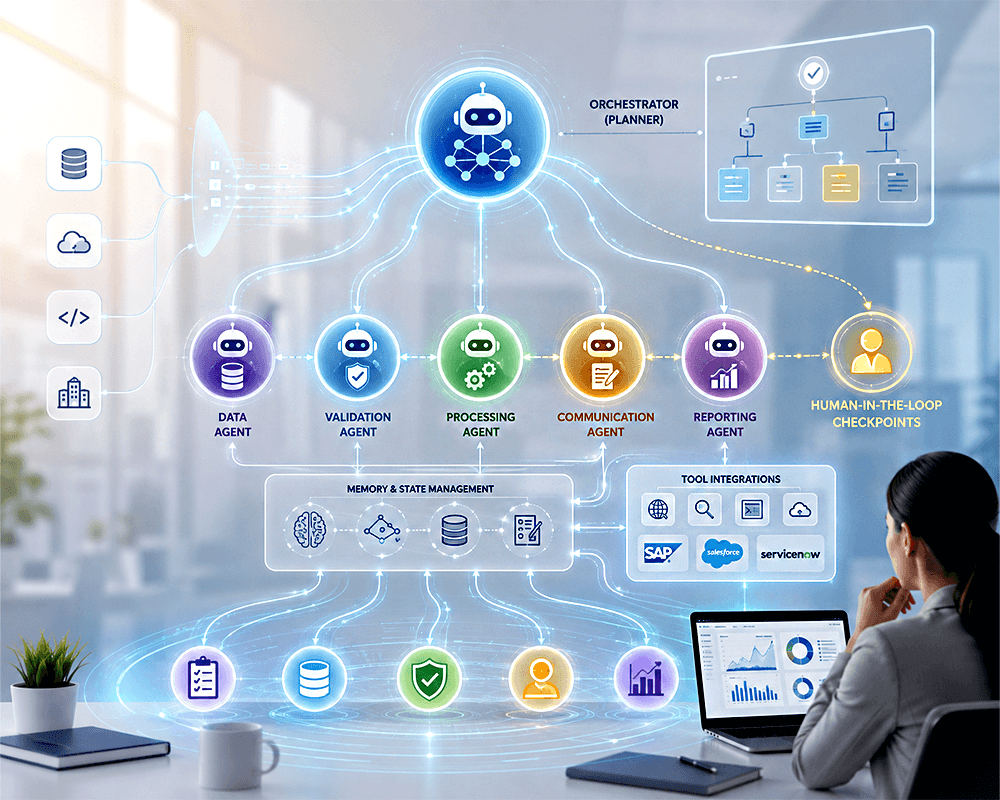
Orchestrator (Planner)- This is the agent that breaks a goal down into a task graph; it doesn’t do the work itself, it delegates. A good one tracks dependencies between tasks, re-plans when something fails, and knows when to pull in a human. Basically, the project manager of the whole operation.
Specialist Sub-Agents- Rather than one agent trying to do everything, you want narrow, purpose-built agents, one for pulling data, one for validation, one for running code, one for communication. Specializing isn’t a compromise; it’s what makes debugging manageable and reliability actually achievable.
Memory and State Management- Agents need short-term working memory for the task at hand, plus long-term memory for things like user preferences, past decisions, and domain knowledge. Depending on how fast and how persistent that memory needs to be, you might reach for vector databases, structured stores, or shared state objects.
Tool Integrations- An agent with no tools is just an expensive text generator. Real systems connect their agents to APIs, databases, code interpreters, web search, and enterprise platforms like SAP, Salesforce, or ServiceNow. How much your agents can actually get done comes down to how well-built this layer is.
Human-in-the-Loop Checkpoints- Autonomy without any oversight isn’t a feature, it’s a liability. The systems that work well have clear points where a human steps in to review, approve, or redirect.
Architectural Patterns Worth Knowing
Frameworks like LangGraph, Microsoft AutoGen, and CrewAI have popularised several interaction patterns. Three matter most in enterprise contexts:
Hierarchical (Orchestrator-Worker)- The most common pattern. One orchestrator breaks down goals and assigns tasks to specialist workers. It maps naturally to how human teams are structured and makes role boundaries explicit. Best suited for sequential, pipeline-style workflows.
Peer-to-Peer (Collaborative)- Multiple agents with equivalent authority collaborate, checking each other’s outputs, challenging assumptions, and arriving at a consensus. Research teams at Microsoft have used this approach for code review and complex analysis tasks where one agent’s blind spot is another’s strength.
ReAct + Reflection Loops- An agent reasons, acts, observes the result, then reflects before the next step. This is the foundation of LangChain’s planning agent work and maps closely to how consultants approach structured problem-solving. The downside is latency; the upside is significantly fewer catastrophic errors on ambiguous tasks.
The Business Case Is Not Theoretical
Sceptics often treat multi-agent systems as a sophisticated solution looking for a problem. The ROI data disagrees. Enterprises deploying agentic AI are reporting an average 192% ROI from agentic deployments (Landbase, 2026), with 62% expecting returns above 100%. Separately, PwC survey data shows 79% of organizations have implemented AI agents at some level, and 96% of IT leaders plan to expand their agentic AI footprint through 2025 and beyond.
The market itself reflects this confidence. The global agentic AI market, valued at $6.23 billion in 2024, is projected to reach $107.28 billion by 2032- a CAGR of 42.85%. Enterprise-focused deployments alone are expected to grow from $2.58 billion in 2024 to $24.50 billion by 2030.
But the failure statistics deserve equal attention: 40% of agentic AI projects fail, and it’s rarely the model or the idea behind it that’s to blame; it’s how the system was put together, sloppy handoffs between agents, no fallback when a tool call fails, no clear line for when a human needs to step in. That’s the pattern most organizations learn the hard way.
What Actually Fails in Production
After working through multi-agent implementations across enterprise contexts, from SAP-integrated workflows to document-intensive approval chains, the failure patterns cluster around three areas, and all three come down to architecture, not the model:
Context degradation over long task chains- As tasks pass between agents, critical context gets summarized away. The seventh agent in a chain often has a distorted view of what the first agent established. Designing explicit state-passing contracts between agents, rather than relying on conversation summarization; is the fix.
Tool call failures with no graceful fallback- An agent that hits a 503 from an external API and has no retry logic or alternative path simply breaks the whole chain. Fault tolerance is not optional, it’s architecture.
Underdefined human escalation paths- Systems that escalate “when something goes wrong” inevitably create ambiguity about when that threshold is reached. The better approach: define escalation explicitly by confidence score, by decision risk, by task category, before you build.
Where Leaders Should Start
If you are responsible for an organization’s AI roadmap, the question is not whether multi-agent architecture is relevant; it is. The question is where to start without overbuilding.
Start with a process that’s already well-defined- Procurement approvals, onboarding, compliance checks, support ticket triage, these are high-value, clearly bounded workflows where handing off between agents maps naturally onto handoffs that already happen between people.
Invest in observability before you invest in capability- You cannot improve what you cannot trace. Every agent action, tool call, and handoff should be logged with timestamps, inputs, outputs, and decision rationale. This is what separates deployable systems from demos.
Treat agent design as org design- The best multi-agent setups look a lot like the best human teams: clear ownership, no ambiguity about who’s responsible for what, and an obvious path for escalating when something needs a person. If you wouldn’t structure a human team that way, don’t structure an agent team that way either.
The conversation has already moved on
Somewhere along the way, the enterprise AI conversation stopped being about “can it do this?” and quietly became “how do we build systems that do this reliably, at scale, and in a way, we can actually be accountable for?” Multi-agent architecture isn’t just an answer to that question, it’s the only workable one. A single model can’t own memory, recovery, and accountability all at once; a deliberately coordinated set of agents can. That’s not a trend. That’s the structural baseline for AI that does real work.
The organizations pulling ahead are not the ones with access to the best models. The companies pulling ahead are the ones treating this with real architectural discipline- agents with well-defined roles, memory that actually persists and means something, tools wired into real business systems, and humans still in the loop wherever it counts. That’s not something you throw together over a weekend, and it’s not something competitors catch up to easily once it’s built right. That head start is the whole point.
Get the architecture right. The intelligence will follow.