August 11, 2026 By: Paul Velardo
Ask a CPG executive about their AI strategy, and you’ll get a confident answer. Ask the analyst stitching together five spreadsheets before Monday’s meeting, and you’ll get something closer to the truth. Consumer expectations move fast. Retail keeps splintering into new channels. Supply chains break in ways nobody predicted. Collecting more data isn’t the advantage it used to be. Acting on it fast is.
McKinsey’s 2024 survey put a number on this: 71% of CPG leaders had adopted AI in at least one business function, up from 42% just a year earlier. The ones who did it well saw real revenue gains. The ones still figuring it out are falling further behind every quarter, not because they lack data, but because they can’t get to it fast enough.
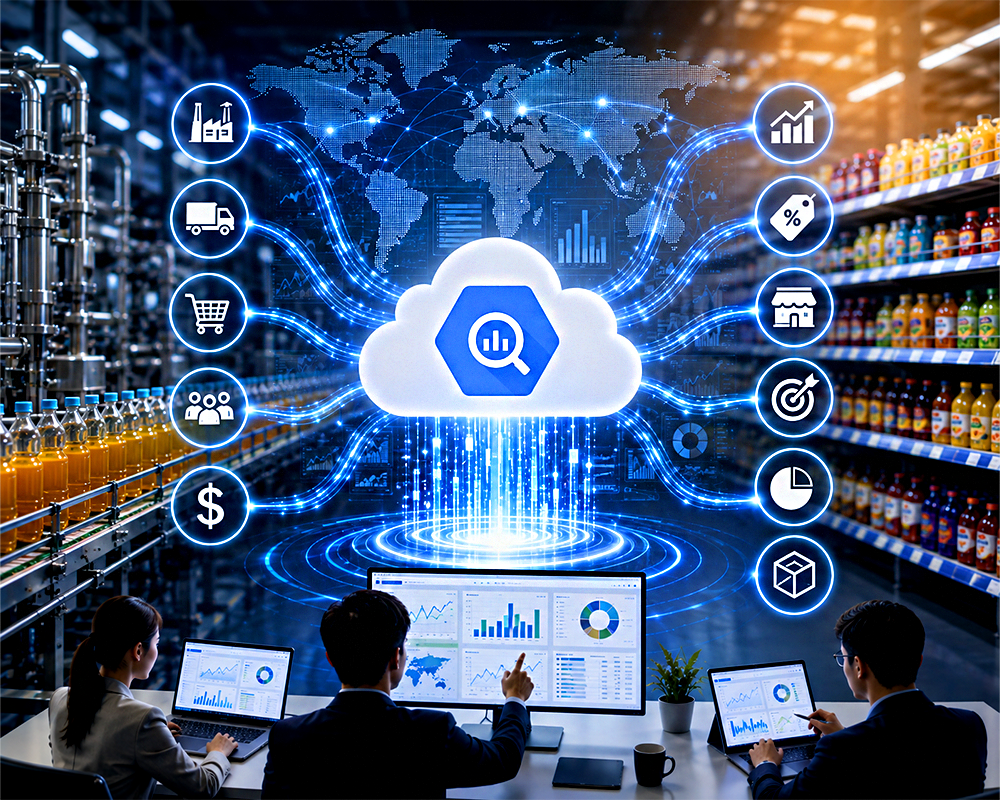
This is where Google Cloud BigQuery comes in. It pulls manufacturing, supply chain, retail, marketing, finance, and customer data into one place instead of five. No more stitching numbers together from different systems before a meeting. One source, one platform, and because BigQuery is built for real-time analysis, a much shorter gap between something happening and someone noticing.
Why BigQuery Matters for CPG
Unified, Real-Time Data
Most CPG data lives in silos: POS systems, inventory platforms, promotion calendars, distributor networks, ecommerce, direct consumer feedback. None of it talks to the others without help. BigQuery is that help. It brings the sources together so a trend shows up while it’s still forming, not three weeks later in a report nobody reads until Friday. McKinsey puts a number on what that’s worth: AI-driven demand forecasting can cut forecast errors by 20 to 50%, and cut stockout-related lost sales by up to 65%. That’s not a rounding error. That’s real money.
Breaking Down Data Silos
Disconnected systems are still the single biggest reason CPG companies can’t get an honest, company-wide view of how they’re doing. Manufacturing data sits in one system, retail in another, marketing somewhere else entirely, and by the time someone reconciles it all by hand, the numbers are stale. BigQuery gives every team the same foundation to work from. Reporting stops being a manual reconciliation exercise and starts being something people actually trust.
Predictive Analytics with Built-In Machine Learning
BigQuery ML lets analysts build predictive models right inside the warehouse. No exporting data to a separate ML platform, no waiting on a data science team with its own backlog. Forecast demand. Adjust pricing. Predict how a promotion will land before it launches. Flag a supply chain risk before it becomes a shortage. Keeping the modeling next to the data cuts out most of the delay that usually kills momentum on projects like this.
Scalable and Cost Efficient
BigQuery is serverless and fully managed, so it scales automatically and you pay for what you use, nothing more. No infrastructure to plan around, no servers to maintain. A ten-person D2C brand can run the same caliber of analytics as a company twenty times its size, without hiring anyone to babysit a data center.
Business Value Across the Enterprise
This isn’t a one-department tool. It shows up everywhere:
- Demand forecasting and inventory optimization
- Trade promotion effectiveness
- Retail and distributor performance analysis
- Marketing attribution and customer segmentation
- Financial reporting and profitability analysis
- Supply chain visibility and disruption monitoring
Real-World Impact
Mattel is a good example of what this looks like in practice. Working with Google Cloud, the company rebuilt how it processes consumer feedback and came away with roughly 100x more data capacity. Insight generation that used to take a month now takes about a minute. That’s not a marginal improvement, it changes what’s possible day to day. Audience segmentation gets sharper. Fans get responses that feel immediate instead of delayed. Product decisions get made with feedback that’s actually current, not six weeks stale.
Conclusion
The CPG companies pulling ahead over the next few years won’t be the ones sitting on the most data. Plenty of companies already have that. They’ll be the ones that can turn data into a decision before the moment passes. Google Cloud BigQuery is built for exactly that: everything in one place, machine learning built in rather than bolted on, and room to scale without a heavier infrastructure bill. Whoever gets that foundation right first isn’t just moving faster. They’re setting a pace competitors will spend years trying to catch.