November 16, 2026 By: JK Tech
Technology rarely changes the way businesses operate overnight. More often, the shift happens gradually. A new tool enters the workplace, a process becomes automated, or a decision that once took days can suddenly be made in minutes. Over time, these small changes begin to reshape entire industries.
Artificial intelligence is perhaps the clearest example of this shift. What started as a way to automate repetitive tasks has grown into something much bigger. Businesses are now exploring how AI can support decision-making, improve customer experiences, make better use of data and manage complex operations.
But AI is only one part of the picture.
Developments in quantum computing, biotechnology, connected devices, robotics and energy infrastructure are progressing alongside it. More importantly, these technologies are beginning to overlap. Their combined capabilities could change not just how businesses operate, but also how they compete, innovate and respond to new challenges.
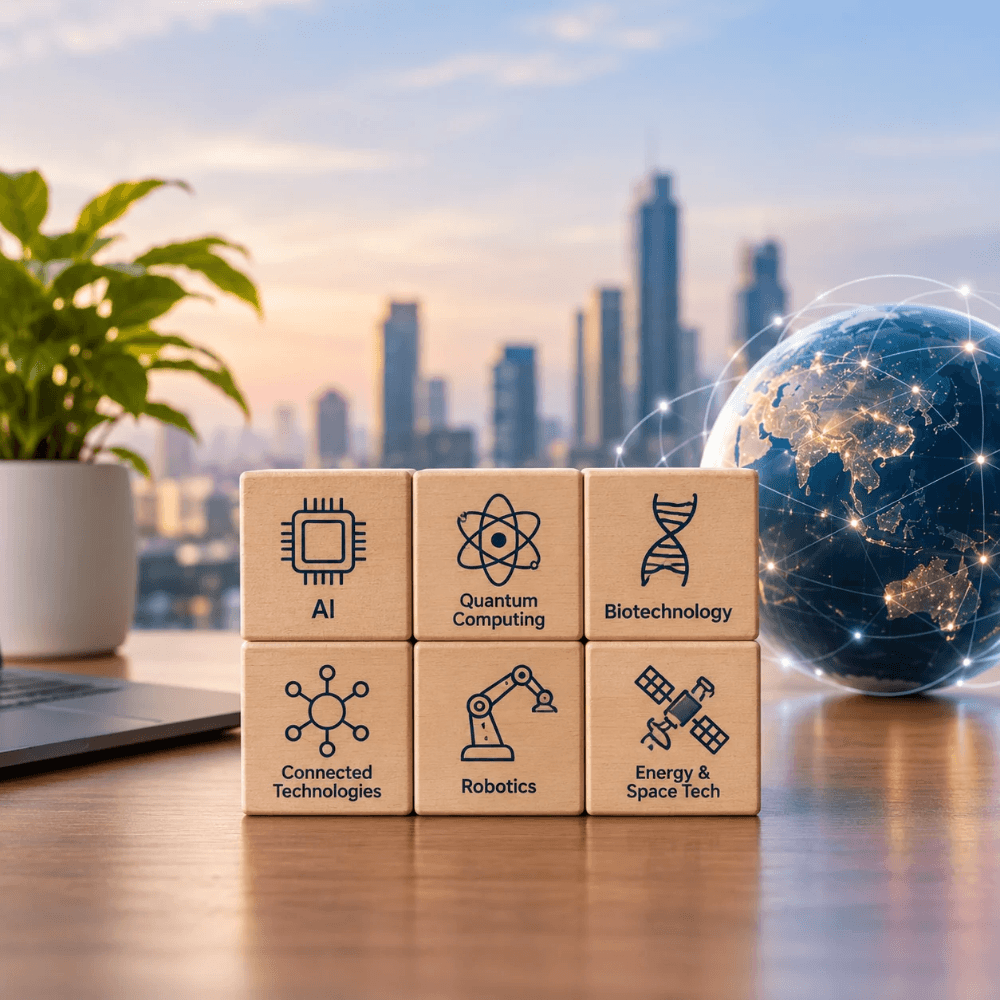
Here are six technology trends likely to have a significant influence on the coming decade.
1. Artificial Intelligence Is Becoming a Business Capability
AI has moved well beyond the experimental stage. Businesses are no longer asking only whether they should use it. They are increasingly looking at where it can make a meaningful difference to their operations.
One of the biggest developments is the move towards AI agents. Unlike conventional AI tools that respond to individual prompts, these systems can handle sequences of tasks, work with different sources of information and carry out activities within defined boundaries.
For businesses, this opens up several possibilities. Customer service teams can use AI to handle routine enquiries and support more complex interactions. Finance departments can automate parts of reporting and analysis.
Supply chain teams can use predictive insights to anticipate demand and identify potential disruptions.
The real opportunity lies in connecting AI with existing business processes rather than treating it as a separate tool.
However, successful adoption involves more than choosing a powerful AI model. Businesses need reliable data, clearly defined workflows, appropriate access controls and ways to understand how AI-generated decisions are made. Without these foundations, even advanced systems may struggle to deliver consistent results.
As AI becomes more deeply integrated into enterprise operations, governance and accountability will become just as important as the technology itself.
2. Quantum Computing Could Take Computing Beyond Its Current Limits
Traditional computers have become incredibly powerful, but certain scientific and mathematical problems remain difficult to solve, even with advanced computing infrastructure.
Quantum computing offers a different approach.
Instead of processing information through conventional binary bits, quantum computers use quantum bits, or qubits. This allows them to approach certain calculations in ways that classical systems cannot easily replicate.
The technology is still developing, but its potential applications are attracting interest across several industries. Pharmaceutical researchers could use quantum computing to study molecular interactions. Financial institutions may explore its use in complex risk modelling and optimisation. Energy companies could investigate new materials and ways to improve resource management.
It is unlikely that quantum computers will replace conventional computing systems. A more realistic possibility is that both will work together, with quantum systems handling specialised problems and traditional infrastructure supporting everyday business operations.
There is also a cybersecurity consideration. Advances in quantum computing could eventually challenge some of the encryption methods used to protect digital information today.
For organisations, this makes it important to start understanding post-quantum cryptography and assess how prepared their existing security infrastructure is for future developments.
3. Biotechnology Could Make Healthcare More Personalised
Healthcare has traditionally relied on treatments developed for broad groups of patients. But advances in biotechnology are making it increasingly possible to understand diseases and treatment responses at an individual level.
The combination of genetic research, AI and advanced computing is helping scientists analyse biological information and identify patterns that were previously difficult to detect.
This could lead to more personalised treatment approaches, where medical decisions are informed by a patient’s genetic profile, medical history and other individual factors.
AI is also supporting drug discovery by helping researchers examine large datasets, identify potential compounds and narrow down areas for further investigation. Gene-editing technologies are creating new possibilities for addressing certain inherited conditions.
The impact of biotechnology is not limited to healthcare. Agriculture is another area where these developments could prove valuable. Research into climate-resilient crops, disease resistance and alternative food production methods could help address growing concerns around food security and changing environmental conditions.
For businesses, biotechnology is an example of how data and computing capabilities can accelerate innovation in fields that extend far beyond traditional IT.
At the same time, the handling of genetic and biological information requires strong safeguards. Privacy, ethical research practices and responsible use of data will remain essential as these technologies develop.
4. Connected Technologies Are Making Business Operations More Intelligent
Businesses generate enormous amounts of information through their everyday activities. The challenge is turning that information into something useful while events are still unfolding.
Connected technologies are helping address this gap.
The Internet of Things (IoT), intelligent sensors, faster communication networks and edge computing allow devices and systems to collect and exchange information in real time.
In manufacturing, sensors can monitor equipment performance and identify signs of a possible breakdown before it interrupts production. Retailers can use connected systems to track inventory and understand customer behaviour. In logistics, real-time information can help businesses monitor shipments and respond to delays.
Smart infrastructure is another growing application. Connected electricity grids can respond to changing demand, while intelligent building systems can manage lighting, temperature and energy consumption more efficiently.
Drones are also becoming useful across agriculture, infrastructure inspection, logistics and emergency response.
But collecting more information does not automatically lead to better decisions. Organisations need systems that can bring information together, maintain data quality and make insights accessible to the people who need them.
This is where the relationship between connected devices, data platforms and AI becomes particularly important. When these technologies work together, businesses can move from simply monitoring operations to making more informed and timely decisions.
Security remains an important consideration, especially as connected devices become part of critical business infrastructure.
5. Robotics Will Change the Relationship Between People and Machines
Automation has been part of industrial operations for decades. What is changing is the range of tasks machines can perform and the environments in which they can operate.
Advances in AI, computer vision and sensor technology are allowing robots to understand their surroundings, recognise objects and respond to changing conditions.
In manufacturing, robots can support assembly and quality inspection. Warehouses are increasingly using autonomous systems to move goods and manage inventory. Healthcare providers are exploring robotic assistance for surgical procedures and patient care. Agricultural robots can help with monitoring, planting and harvesting.
The development of more adaptable robots is also creating interest in environments where tasks are repetitive, physically demanding or potentially dangerous for people.
For businesses, the value of robotics is not simply about reducing manual effort. It is also about improving consistency, productivity and workplace safety.
However, introducing automation requires careful planning. Employees need opportunities to develop new skills, and organisations must consider how people and machines will work together.
The demand for professionals who can manage automated systems, analyse operational data and maintain robotic infrastructure is likely to grow. Businesses that invest in their workforce alongside automation will be better equipped to manage the transition.
6. Energy and Space Infrastructure Will Support the Next Wave of Digital Growth
The expansion of digital technology brings an important question: can the infrastructure supporting it keep up?
AI applications, cloud platforms and large-scale data centres require substantial computing resources and electricity. As businesses increase their use of these services, demand for reliable and efficient energy systems will continue to grow.
This is driving interest in smarter electricity grids, advanced battery storage and improved energy management.
AI can help forecast electricity demand, identify inefficiencies and support better distribution of available resources. Combined with renewable energy and storage technologies, these developments could make energy networks more adaptable.
Space infrastructure is another important part of the picture.
Satellite networks support navigation, telecommunications, weather forecasting, agriculture and several essential commercial services. Their role is becoming increasingly important as businesses and governments depend on real-time information and reliable global connectivity.
As these systems expand, protecting them from cyber threats, signal interference and other disruptions will become a priority.
For businesses, the larger takeaway is that digital transformation depends on more than software and computing power. It also relies on dependable physical infrastructure, secure networks and access to energy.
Bringing the Technologies Together: What It Means for Businesses
Looking at these six developments individually is useful, but their greatest impact may come from how they work together.
Consider a modern manufacturing operation. Connected sensors collect information from equipment and production lines. AI analyses that information to identify inefficiencies and anticipate maintenance requirements. Robotics supports physical operations, while intelligent energy systems help manage electricity consumption.
Each technology has a role, but the value comes from connecting them into a functioning system.
The same principle applies to retail, healthcare, financial services and other industries. Businesses that can bring together their data, applications and operational processes will have more opportunities to use emerging technologies effectively.
This also means that technology adoption needs to be approached differently. Investing in individual tools without considering the wider business environment can lead to disconnected systems and limited results.
Organisations need to think about data quality, integration, security and governance from the beginning. They also need to ensure that employees understand how new systems work and where human oversight remains necessary.
AI, in particular, will play an increasingly important role in this transition. But its success will depend on the quality of the information it works with, the processes it supports and the safeguards surrounding its use.
The next decade will bring plenty of technological breakthroughs. Some will create entirely new opportunities, while others will improve systems that businesses already depend on.
For organisations, the challenge is not to adopt every new development as soon as it appears. It is to understand which technologies address real business needs, how they can work together and what it takes to implement them responsibly.
That is where the real value of technological progress will be measured: not simply by what a technology can do, but by the difference it makes to the way businesses operate.