April 3, 2026 By: JK Tech
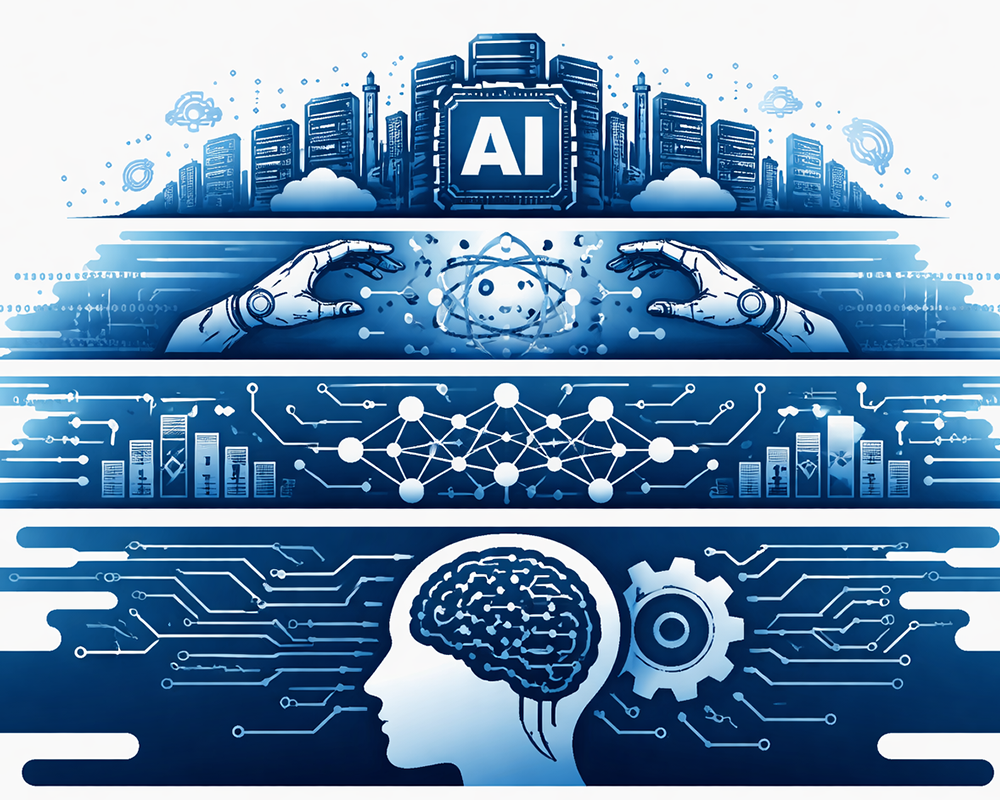
Jensen Huang’s article “AI is a 5 Layer Cake” just described the biggest infrastructure bet in human history, here’s what it actually means. The article is a piece that cuts through a lot of the AI noise. His argument is AI isn’t a clever app or a chatbot. It’s essential infrastructure just like electricity and the internet, and it’s built in five layers: energy → chips → infrastructure → models → applications. Every AI tool is asked a question, electrons move, heat is managed, and computation happens in real time. Behind the magic on the screen there is a supply chain and someone has to build every part of it.
“We are a few hundred billion dollars into this buildout. Trillions of dollars of infrastructure still need to exist. This is the largest infrastructure buildout in human history.” -Jensen Huang
Let’s talk about what this means for governments, tech companies and end users.
Trends To Watch Out For
1. AI Becomes Foundational Infrastructure: AI will transition from applications to utility-like platforms that are offered by cloud providers like AWS, Microsoft Azure, and Google Cloud. These platforms will be embedded everywhere and consumed on demand.
2. Massive Investment in Compute & Energy: Scaling AI is highly dependent on the availability of high-performance chips and reliable power, as training and running large models demand extensive compute and energy-intensive data centers. Companies like NVIDIA, alongside governments are accelerating investments across GPUs, hyperscale data centers and energy infrastructure to support this growing demand.
3. Shift to AI-Native & Vertical Solutions: Movement from generic tools to deeply integrated, industry-specific AI systems (healthcare, finance, supply chain) that span the full stack, from proprietary data pipelines to models and end-user applications enabling higher accuracy, compliance and workflow integration.
4. Rise of Autonomous Agents & Workflow Automation: AI is evolving from assistive copilots to multi-step agents that can plan, execute and adapt across tasks, interacting with APIs, databases and enterprise systems to automate end-to-end business processes with minimal human intervention.
5. Data & Architecture as Differentiators: Data and how it is set up is becoming very important to companies. Having data that is your own and using a mix of cloud and edge systems to make things work better and faster is key. Making sure models work well and do not cost much is also important. It is not about having the basic models.
6. Shift in Workforce Demand and Skill Composition: Demand will expand beyond model development to roles across the stack, including data engineering, AI operations (MLOps/LLMOps), systems engineering and infrastructure management. In parallel, there will be increased need for skilled trades supporting physical AI infrastructure (data centers, energy systems). The workforce will skew toward hybrid skill sets combining domain expertise with the ability to work effectively alongside AI systems.
What ties all of this together is a shift in how AI use should not be limited to a feature layer, but as a foundational system that other technologies and industries will increasingly rely upon.
For governments, this calls for a focused investment in infrastructure, energy and digital capacity, it’s central to economic competitiveness and resilience. For technology companies, the opportunity extends beyond building applications to owning and optimizing different layers of the stack, from compute to platforms to domain-specific solutions. And for end users, the impact will be experienced less as disruption and more as continuous enhancement, tools becoming more efficient, workflows becoming more smoother and decision-making becoming more informed.
The most important takeaway is that value will not be created at just one layer. It will emerge across the entire ecosystem, from those building the “oven” to those designing what runs inside it. As AI becomes more embedded, the difference between “using AI” and simply “doing work” will start to disappear.
This is still an early-stage buildout. The infrastructure is being laid, the systems are maturing, and the use cases are evolving. The organizations and individuals that recognize this shift early and position themselves within this stack will be the ones best placed to capture the long-term upside.