June 5, 2026 By: JK Tech
Most of us have walked past those green exit signs without giving them much thought. Fire breaks out, follow the signs, get out. That’s the plan. But anyone who has studied how fires actually behave knows that plan has a pretty serious flaw: the nearest exit isn’t always the one you want to be heading toward.
Smoke moves fast and doesn’t follow a straight line. A hallway that’s passable one minute can be completely choked two minutes later. Standard evacuation systems weren’t really built to deal with that kind of uncertainty. They point you somewhere and hope for the best.
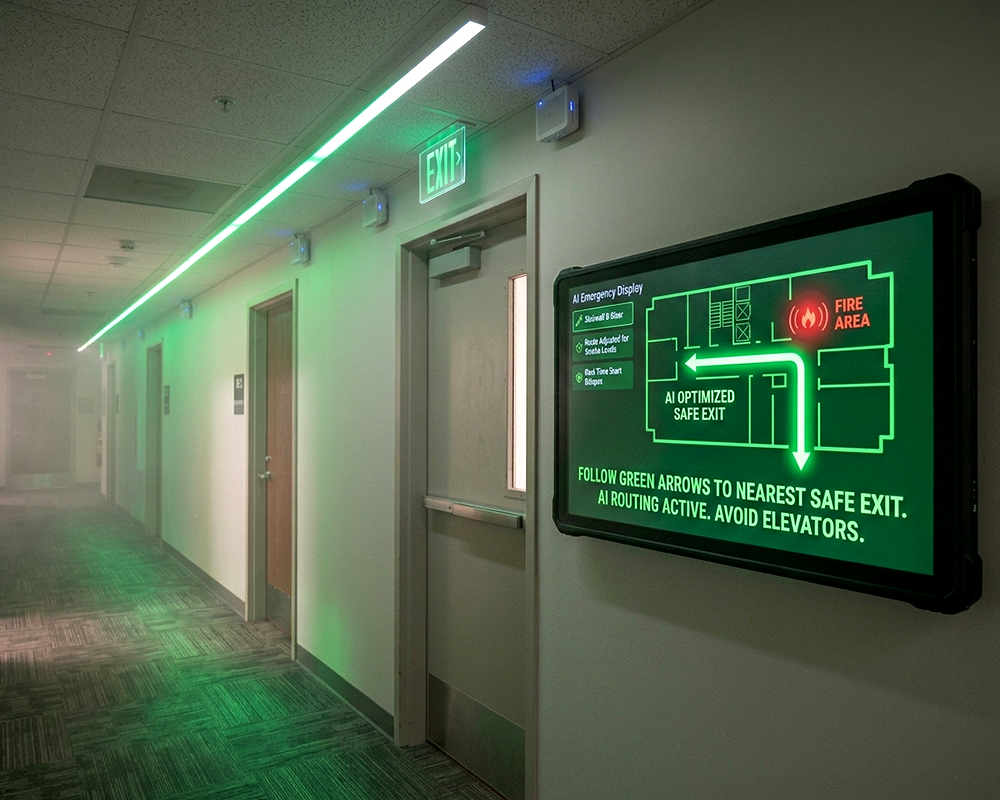
Researchers at National Institute of Standards and Technology (NIST) have been working on something that takes a different approach. Their system, called Safe Step, uses AI to track how a fire is developing and adjust evacuation recommendations on the fly. Instead of just measuring distance to an exit, it’s trying to figure out which route will actually keep you alive given what the fire is doing right now and what it’s likely to do next.
The team trained it using reinforcement learning. Basically, they ran the AI through enormous numbers of fire scenarios, letting it figure out through trial and error which decisions tended to lead to better outcomes. It picked up on patterns that would be nearly impossible for a person to calculate under pressure.
One thing the system pays close attention to is something called Fractional Effective Dose, a measure of how much toxic gas exposure a person can take before it becomes incapacitating. It sounds technical, but the idea is straightforward: some routes expose you to more of that danger than others, and the AI weighs that when it makes a suggestion.
Testing so far has been limited to single-story layouts, which are obviously simpler than a real office building or hospital. The researchers are aware of that gap. They’re currently figuring out how to apply the same logic to multi-floor buildings, and also how to model what happens when you’ve got dozens or hundreds of people evacuating at the same time. Crowd dynamics, bottlenecks, people freezing up or going the wrong way, that stuff matters a lot and it’s hard to simulate well.
It’s still a research project. Nobody is installing this in buildings yet. But the underlying idea is genuinely interesting because emergencies are exactly the kind of situation where static, pre-planned responses tend to fall apart. If a system can read what’s actually happening and respond to it, that’s a different category of tool than anything we currently have on a wall next to a fire extinguisher.