April 17, 2026 By: Sanjeev Motwani
Why Cloud-Led Intelligence Is Now a Boardroom Priority
Inventory has always been important for growth, cost management, and customer trust in the CPG industry. What has changed is the margin for error.
Volatile demand patterns, shorter product lifecycles, complex channels, and rising sustainability pressures have made inventory management a key differentiator instead of just an administrative task. In this environment, instincts and static planning models are not enough. Leading CPG organizations are viewing inventory as a data and intelligence challenge, not just an operational problem.
This is where cloud-led platforms, especially Google Cloud, are transforming how inventory decisions are made, managed, and expanded.
Inventory Optimization Is No Longer an Operational Exercise
For years, inventory optimization focused on controlling costs by reducing excess stock, improving turnover, and avoiding stockouts. Today, it encompasses much more. Inventory decisions now directly impact:
- Revenue realization across channels
- Customer experience and brand trust
- Working capital efficiency
- Waste, emissions, and ESG outcomes
AI adoption in demand forecasting is growing rapidly: 45% of companies have already incorporated machine learning into forecasting processes, with adoption continuing to rise as accuracy and operational value become clearer.
The most successful CPG leaders are changing the question from “How much inventory do we carry?” to “How do we continuously match inventory with real demand, in real time, across the network?”
That shift requires predictive intelligence, not just occasional reporting.
From Visibility to Foresight: The Cloud Advantage
Cloud-based inventory management is not just about “putting data in the cloud, it’s about now having the foresight at scale.”
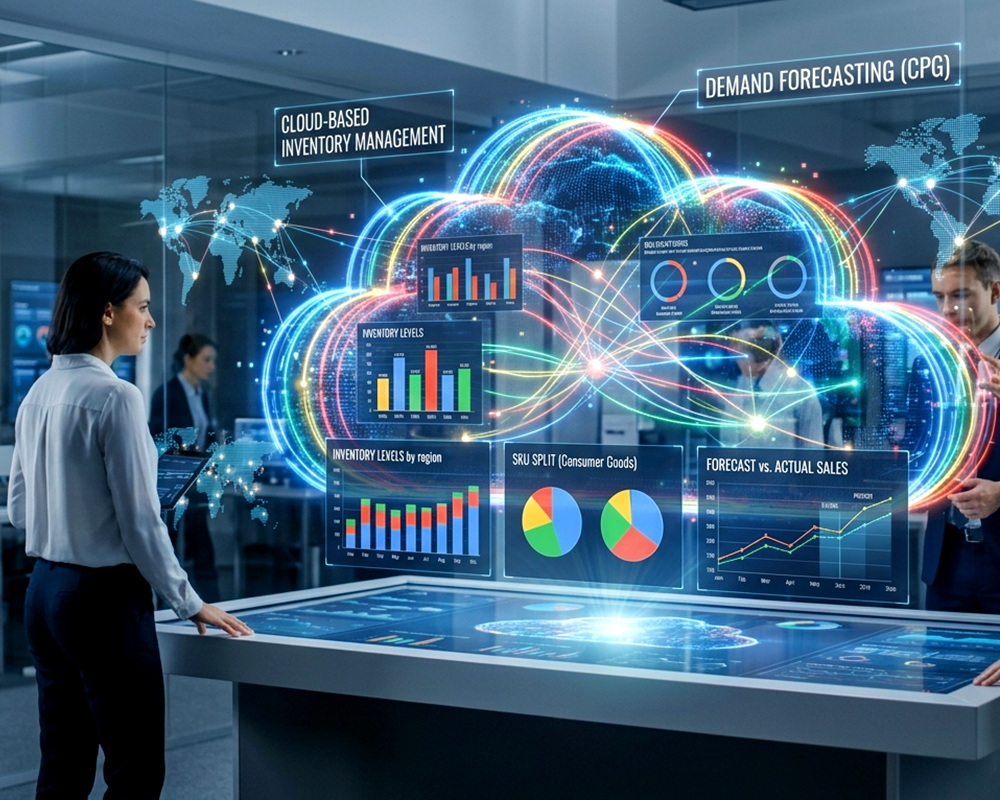
With a variety of data sources, from ERP, POS, and logistics partners and suppliers to external signals, Google Cloud can help shift inventory planning from lagging indicators to forward-looking decision models. Leaders can use platforms like BigQuery and Vertex AI to:
- See emerging demand patterns up front
- Model the tradeoffs between service level, cost and inventory availability
- Project the downstream physical effects of promotions, disruptions or constraints in supply
- Improving efficiency and adding more decision intelligence up the chain.
Google Cloud’s CPG Solution Stack: From Data to Decisions
What makes Google Cloud particularly well-suited for CPG inventory management is the depth of its purpose-built solution stack. Rather than a single tool, it is a layered set of capabilities that work together across the data-to-decision journey:
- BigQuery + Cortex Framework serves as the unified data foundation, ingesting ERP data from SAP and Oracle, WMS, POS, ecommerce, and external signals into a single analytical store. This eliminates the data silos that have historically paralyzed CPG planning teams.
- Vertex AI Forecast enables per-SKU, per-store demand forecasting with promotion-adjusted models and optimized safety stock calculations. It continuously learns from new data, improving accuracy over time without manual retraining.
- Shelf Checking AI monitors on-shelf availability, planogram compliance, and detects lost sales risk from empty or mis-shelved product—feeding real-time signals back into inventory replenishment decisions.
- Gen AI via Vertex AI powers natural-language “supply chain control towers” where planners can ask questions like “Where do I have excess aging stock of SKU X, and what’s the optimal reallocation?” and receive data-grounded recommendations instantly.
- With Agentic AI layered on top, the system moves beyond insights to action, autonomously simulating scenarios, triggering workflows, and executing decisions such as stock reallocation or replenishment updates.
- This marks a shift from decision support to self-optimizing, intelligent supply chain operations.
The narrative arc is straightforward: build the data foundation, sharpen forecasting, execute across stores and distribution centres, then continuously improve through Gen AI copilots. Each layer compounds the value of the next.
Inventory Optimization: The New Strategic Capability
Inventory optimization is no longer a planning function at some of the top CPG organizations, it’s a continuous capability powered by systems.
With Cloud-based optimization, leaders can:
- Balance inventory at scale across warehouses, regions and channels
- Replenishment patterns to match consumption rather than historical averages
- Tune optimizing systems away from “scribbling in the sand” (manual interventions) to “frictionless” adjustments.
Global leaders have already demonstrated what is possible. Retailers using AI-driven forecasting and optimization have reported material reductions in waste, improved availability, and more sustainable operations, proving that smarter inventory is both economically and environmentally sound.
Real-World Proof Points: This Isn’t Slideware
The following examples show what measurable change looks like when Google Cloud is applied to real inventory and forecasting challenges:
- Super-Pharm (pharmacy/retail): Using Vertex AI on Google Cloud, Super-Pharm improved demand forecasting efficiency 10x and lifted inventory accuracy from 50% to 90%. The result was smarter inventory positioning and better merchandising decisions across their entire network.
- Cainz (home improvement retailer): Rebuilt demand forecasting across 209 stores using Vertex AI Forecast and Cloud Run. Sales data preprocessing was reduced to approximately 50 minutes regardless of store count- a capability that previously did not scale.
- Global CPG leader (via Pluto7): Integrated SAP APO and S/4HANA into Google Cloud Cortex with a “Planning in a Box” solution on BigQuery. This tackled inventory aging with granular visibility, automated alerts, and recommendations for DC splits, sell-off, and scrap decisions—converting what was previously a reactive write-off process into a proactive management capability.
Across these examples, the common thread is not the technology itself- it is the organizational shift from reactive management to predictive action. Google Cloud provides the platform; the measurable gains come from embedding that intelligence into daily decisions.
Breaking Silos to Create a Connected Inventory Centre
Fragmentation is one of the largest barriers in CPG. Data is siloed in systems, functions and partners. Cloud-native inventory platforms break this pattern by creating a single trusted source of truth.
This allows organizations to:
- Bring demand, supply, logistics, and promotion data together on a single platform
- Achieve real-time visibility with suppliers, warehouses, and retailers
- Scale globally without redesigning for each market
And the result is not just better reporting, but commercial, supply chain, and operations staff working from the same reality.
Forecasting with Confidence in an Uncertain World
Forecasting has always been a challenge in CPG. It is even more important today.
Models work with a limited set of data, and struggle to include:
- Rapid changes in consumer behavior
- Fragmented channels
- Impact from external forces such as weather, geopolitical events, or regulatory changes
Modern forecasting on Google Cloud takes advantage of machine learning to model a broader set of signals, such as sales, promotions, seasonality, and external events, in models that are constantly learning.
And the result is not perfect forecasts, but better decisions in an uncertain world: fewer surprises, quicker course corrections, and better resilience.
Intelligent, self-learning inventory is the new growth engine
The next step forward in inventory management isn’t further optimization. It is systems that learn about your business and change as your business changes.
Cloud-based inventory intelligence can enable:
- Gen AI-driven demand sensing across regions and micro-markets
- Predictive, consumption-driven replenishment rather than lookback data
- Scenario simulation to test decisions before they happen
This is a fundamental shift- from managing inventory after outcomes occur, to shaping outcomes before they materialize.
A leadership imperative
For CPG leaders, the question isn’t if they should modernize inventory management. It’s when and how.
Google Cloud makes the foundation. It’s how organizations use that foundation that drives progress:
- Embed intelligence in daily decision-making
- Align inventory strategy with growth, customer and sustainability goals
- Treat inventory as a system and not an asset
Those who take this step don’t just build leaner supply chains. They build more resilient, responsive and future-forward businesses.
The path forward for CPG excellence isn’t stock more or cutting deeper. It’s see sooner, decide smarter and act faster. Cloud-based intelligence is not just enabling that future; it is defining it.