October 9, 2026 By: JK Tech
Somewhere in your home there’s probably a dead-weight phone. Old charger long gone, screen scratched, battery questionable. Too useless to use, too annoying to bin. A team at UCLA looked at exactly that kind of device and saw a robot’s head.
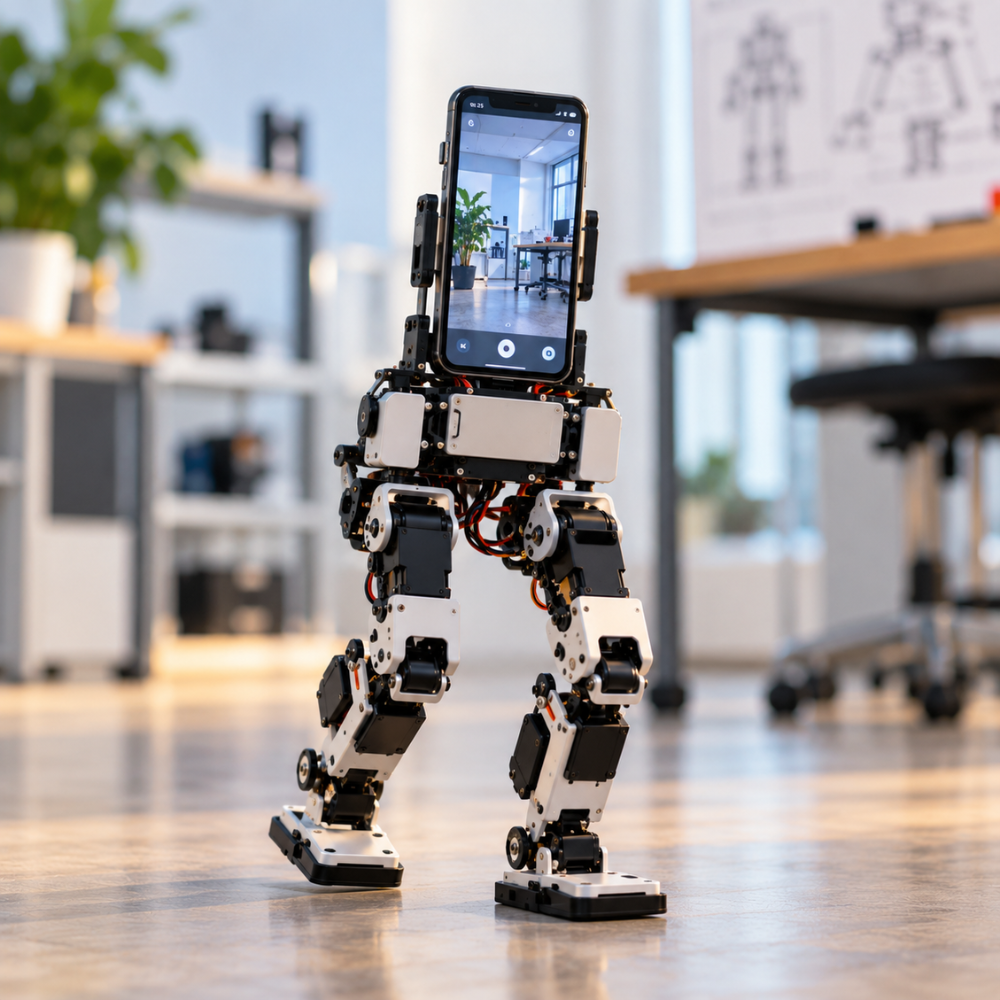
PhoneBot is their small humanoid, and the phone is basically the whole control centre. It watches, balances and decides what the legs should do next. Most robots carry a bundle of dedicated sensors and chips for those jobs. This one leans on an Android handset that already has a camera, motion sensors, a processor and Wi-Fi sitting inside it, all built at huge scale and sold cheap. Why pay twice for hardware that’s already in a pocket?
Size first. About 48 cm tall, around 1.8 kg once the phone is clipped on. Parts cost roughly $400, not counting the phone. Humanoids that can walk usually cost far more than that, so the figure is the real headline for schools and small labs that have always been priced out.
The phone mounts on the upper body. Its camera finds people and keeps track of them. The motion sensors report tilt and turning, which the robot needs to stay upright. Software runs on the phone as well, and instructions go out over Wi-Fi to a small computer on the robot, which drives the motors.
Thirteen motors do the moving. Six per leg. The thirteenth turns the upper body, and that one is cleverer than it sounds, since the camera can look left or right without the feet shuffling around to match. Fewer wobbles that way.
Demos were basic but not trivial. PhoneBot walked on its own and trailed a person using only the phone’s camera. It also fell on its face at one point, then pushed itself up and carried on. Getting back up is a surprisingly hard trick for a small humanoid.
Now the phones. Four got tested: a 2017 Honor 9, a Moto G 2024, a Moto G 2025 and a Samsung Galaxy A16 5G. All of them handled sensing, vision and movement control without drama. A phone nearly a decade old managed fine, which is a bit startling given how quickly people swap handsets.
One snag turned up. The Honor 9 couldn’t run the mapping feature, because the Google services it relies on aren’t available on that model. So an old phone works, but only if the software side still plays along.
Robotics mostly chases newer and more specialised kit. PhoneBot goes the other direction and asks what’s already lying around unused. A few hundred dollars plus a retired handset could be enough for a student to build something that walks and follows people around a room. That’s a much lower bar than most labs have ever offered.
So maybe hold off on throwing that drawer phone out.