May 11, 2026 By: JK Tech
Artificial intelligence is largely associated with digital interactions such as generating content, analyzing data, and supporting decision-making processes, a growing area of development now focuses on how AI systems interact with physical environments through robotics, sensors and real-time intelligence.
This emerging category is referred to as Physical AI, which enables machines to interpret surroundings, respond to changing conditions, and perform tasks with increasing levels of autonomy, from warehouse robotics to intelligent manufacturing systems, organizations are beginning to explore how AI can support operations beyond software-driven workflows. These systems combine AI models with hardware components including sensors, cameras, actuators, and embedded computing infrastructure to process environmental data and execute actions in real time.
How Does Physical AI Work?
As opposed to automation systems which operate through predefined rules and repetitive workflows, Physical AI systems are designed to function in dynamic environments where conditions continuously change. Computer vision, reinforcement learning, motion control, and sensor fusion allow these systems to interpret surroundings, adjust behavior, and improve operational performance over time.
The growing availability of high-performance edge computing and real-time AI processing has further expanded the range of environments where Physical AI systems can be deployed reliably and on a scale.
One of the defining characteristics of Physical AI systems is their ability to process environmental information continuously and respond with context-aware actions, this capability is supported by the integration of machine learning models, real-time sensing and embedded computing systems operating together within physical environments.
Environmental perception forms a foundational layer of these systems. Cameras, LiDAR, proximity sensors and multimodal inputs allow machines to identify objects, detect movement and interpret spatial conditions with increasing accuracy. In industrial environments this enables robots and autonomous systems to operate safely alongside human workers and dynamically changing workflows.
Real-time decision-making is another critical capability. Physical AI systems can evaluate incoming data streams and determine operational responses without requiring constant manual intervention. This becomes particularly relevant in environments such as manufacturing facilities, warehouses, and autonomous mobility systems where timing and precision directly influence operational efficiency.
Adaptive learning further improves system performance over time. By continuously analyzing operational feedback and environmental outcomes, Physical AI systems can refine task execution, improve navigation accuracy, and optimize repetitive processes under varying conditions.
An equally important aspect is human-machine collaboration. Many Physical AI deployments are designed to assist human operators by reducing repetitive workloads, improving workplace safety, and supporting higher precision in operational tasks rather than functioning as fully isolated autonomous systems.
Physical AI in Action
Physical AI systems are increasingly being deployed across industries where operational environments are complex, dynamic, and dependent on continuous real-time decision-making. Improvements in robotics, sensor technologies, and edge AI infrastructure have expanded the practical use cases for autonomous and semi-autonomous systems.
- In manufacturing environments, Physical AI is being used to support inspection processes, predictive maintenance and robotic assembly operations. AI-enabled industrial robots can identify production anomalies, adapt to variations in workflows, and improve operational consistency across high-volume environments.
- Logistics and warehousing operations are also seeing broader adoption of Physical AI systems. Autonomous mobile robots are being deployed for inventory movement, route optimization, and order fulfillment tasks. These systems rely on computer vision and spatial awareness to navigate facilities while operating alongside human workers.
- Healthcare represents another growing area of implementation. Robotic-assisted surgical systems, intelligent patient monitoring platforms, and AI-supported rehabilitation devices are improving procedural precision and operational support within clinical environments.
- In agriculture, Physical AI applications include autonomous machinery, crop monitoring systems, and precision resource management. Real-time environmental analysis allows farming operations to optimize irrigation, identify crop health conditions, and improve field-level efficiency.
Organizations such as NVIDIA, Tesla and Boston Dynamics continue to invest in robotics platforms, embodied AI models, and real-world machine intelligence, contributing to broader industry adoption and ecosystem development.
The Future of Human-AI Collaboration
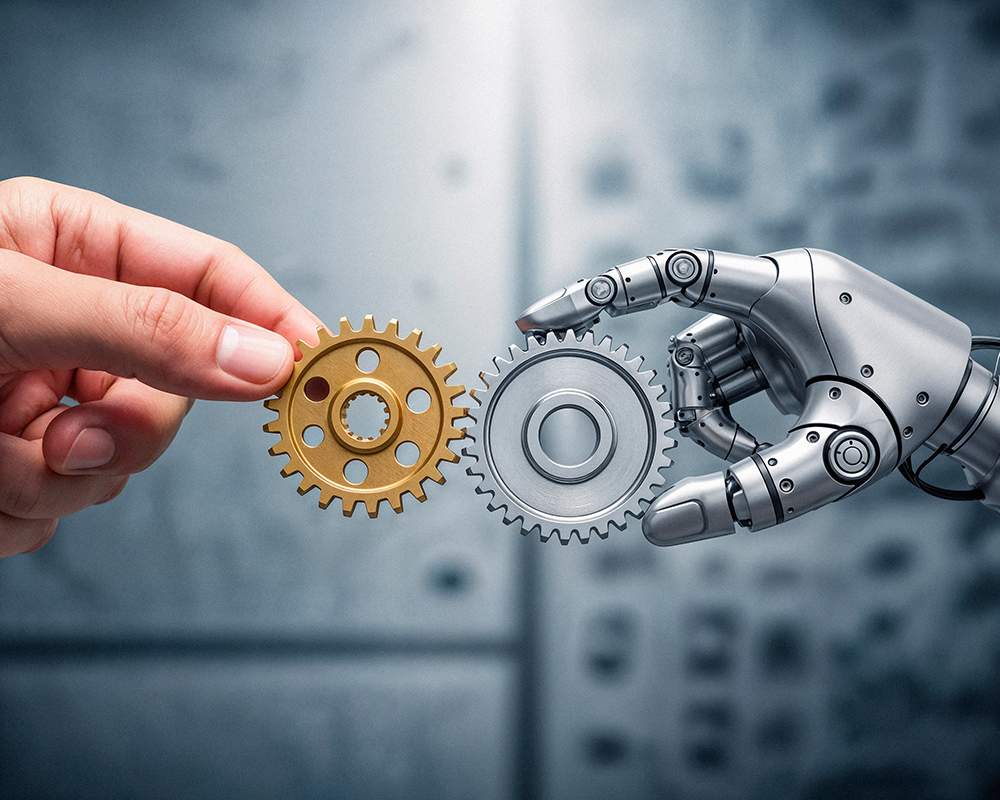
As Physical AI systems become more capable, discussions increasingly focus on how intelligent machines will operate alongside human workers across industrial and enterprise environments. Current adoption patterns indicate that many organizations are prioritizing collaborative models where AI systems support operational efficiency, safety, and precision while human operators continue to manage oversight, judgment, and exception handling.
Advances in robotics, real-time computing, and multimodal AI models are expected to expand the operational range of Physical AI across manufacturing, infrastructure management, healthcare, logistics, and mobility systems. At the same time, deployment considerations such as system reliability, safety standards, and workforce integration will remain central to long-term adoption strategies.
Physical AI represents an important stage in the broader evolution of intelligent automation. As AI systems become more capable of interacting with physical environments, organizations are beginning to evaluate how autonomous technologies can be integrated into operational workflows in practical, measurable, and scalable ways.