July 16, 2026 By: JK Tech
Think about how much of your day is spent looking at a screen.
We wake up and check our phones. We work on laptops. We navigate with maps, reply to messages, order food, watch videos, and end the day scrolling through another feed.
For roughly six decades, screens have been the primary way we interact with computers. Technology has evolved dramatically during that time, but one thing has remained remarkably consistent: to use our devices, we usually have to look at them.
Now, the technology industry is exploring a different possibility.
What if computers could understand the world around us and help us accomplish everyday tasks without requiring our constant visual attention?
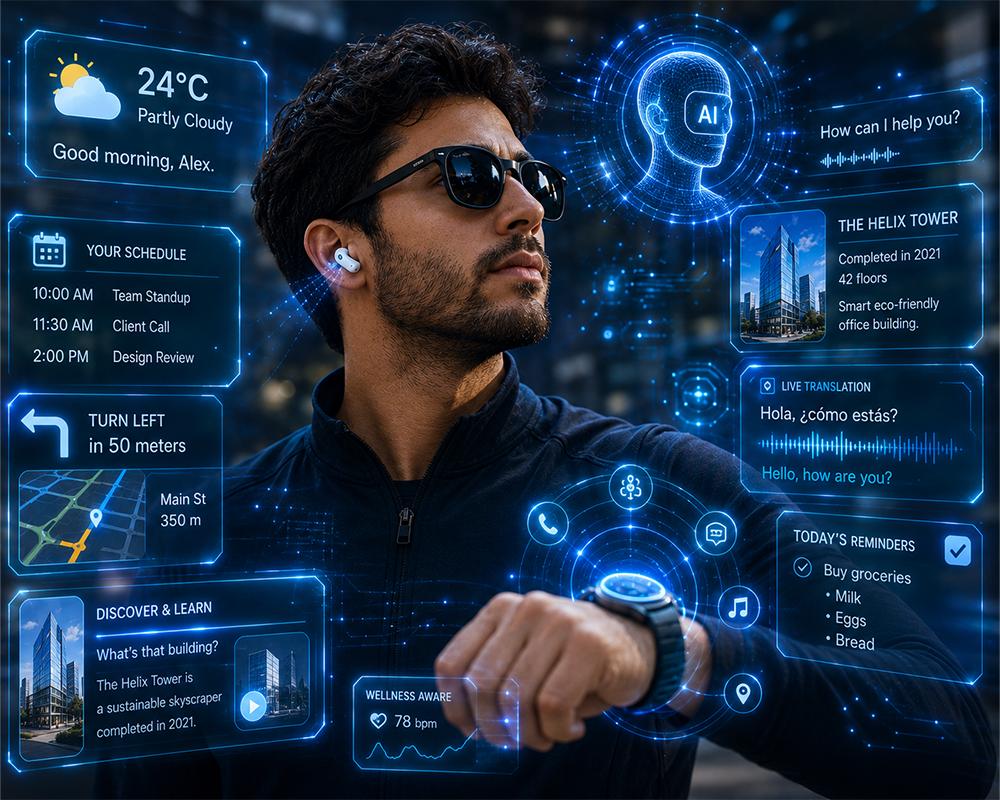
From smart glasses and AI-powered wearables to reports of cameras being added to wireless earbuds, some of the biggest names in technology are experimenting with devices that could push screens further into the background.
It sounds like a future where technology becomes less distracting and more natural.
But it could just as easily create a world where technology becomes even harder to escape.
And before either future arrives, there is a simpler question to answer: do people actually want it?
Technology Wants Us to Look Up
For years, our relationship with computers has largely involved adapting ourselves to the devices we use.
We sit in front of laptops.
We look down at smartphones.
We navigate apps, tap icons, scroll through menus, and switch between screens to accomplish even simple tasks.
Wearable technology could change that relationship.
According to a Bloomberg report referenced by BBC Future, Apple is reportedly developing AirPods equipped with cameras that could arrive as early as next year.
The cameras would not be designed for taking photographs. Instead, they could provide Siri with information about the user’s surroundings, allowing people to interact with their devices based on what is happening in the physical world.
Apple has neither confirmed nor denied the report. However, the information comes from a journalist known for a strong record of reporting developments related to the company.
More importantly, the report is part of a much broader industry trend.
Technology companies are exploring devices that could allow us to perform more computing tasks without constantly reaching for a phone.
Smart glasses, AI pendants, and other wearable devices could gradually shift screens away from the centre of our digital lives.
The ambition is significant.
Instead of stopping to operate technology, technology could begin operating more naturally around us.
Smart Glasses Are Already Testing This Future
This shift is not just theoretical.
Snap, the company behind Snapchat, recently introduced Specs, a new pair of AI-powered smart glasses.
Unlike many smart glasses that depend on smartphones to function, Specs are designed to operate independently from other devices.
The glasses include displays within their lenses, but they are not intended to permanently cover the user’s field of vision. Instead, digital information can temporarily appear over the physical world when needed.
That distinction matters.
The goal is not necessarily to replace the screen with another screen sitting directly in front of our eyes.
It is to make computing available when we need it and less visible when we do not.
That may limit their immediate appeal.
But the larger wearable technology market is growing.
Meta’s smart glasses are currently among the most popular devices in the category, with a reported seven million pairs sold.
The growing interest suggests that technology companies believe wearables could become an important part of how we interact with computers.
But there is a major obstacle standing in the way.
The Privacy Problem Is Impossible to Ignore
Putting cameras into devices that people wear throughout the day creates serious questions.
Smart glasses can make it difficult for people nearby to know whether they are being recorded.
Both Meta and Snap include indicator lights intended to signal when their devices are filming. Critics argue that these signals may not be enough.
The concern is not hypothetical.
Some people have used smart glasses to secretly record strangers or create online content by provoking and filming people without their knowledge.
Even ordinary interactions can become uncomfortable when it is unclear whether someone wearing smart glasses is recording.
That uncertainty could create significant resistance to wearable technology.
Companies are already exploring alternatives.
Meta is reportedly considering smart glasses that rely only on audio and do not include cameras.
Apple could potentially take another approach.
If reports about camera-equipped AirPods are accurate, the cameras may not function like traditional cameras at all. They could simply analyse the user’s surroundings to provide contextual information.
Apple could also theoretically process that visual information directly on the user’s phone without storing it or sending it to cloud servers.
Whether users would find those safeguards sufficient remains another question.
Because the more technology understands about our surroundings, the more useful it can become.
But that usefulness comes with an uncomfortable trade-off.
What Could We Actually Do Without Screens?
Imagine opening your refrigerator and asking your AI assistant what you can cook using the ingredients inside.
No typing out a list.
No searching through recipe websites.
The device can simply understand what you are looking at and respond.
Or imagine walking through an unfamiliar city and receiving directions based on what is directly in front of you.
You could ask questions about objects, buildings, or places without taking out your phone.
Cameras could also enable new ways of controlling devices.
Instead of tapping buttons or navigating menus, people might use gestures or natural conversation.
The possibilities extend beyond convenience.
Today, there are relatively few computing tasks we can perform without looking at a screen.
AI could change that.
At its best, artificial intelligence could allow us to communicate with computers more like we communicate with other people.
Instead of learning how to operate software, we could simply explain what we want to accomplish.
The AI would handle the device on our behalf.
Apple’s upcoming AI-powered version of Siri represents an early step toward this kind of interaction.
And if AI assistants become capable enough, we could spend less time staring at our devices while still benefiting from everything they can do.
The Optimistic Future: Technology That Demands Less Attention
Screen time has become a persistent concern.
Our devices constantly compete for attention.
Notifications interrupt conversations.
Phones come out during meals.
People walk through streets while looking down at screens.
Wearable AI could offer a different relationship with technology.
Instead of repeatedly pulling out a phone, opening an application, and navigating an interface, we could simply ask for what we need.
Technology could become more available while becoming less visually demanding.
We could keep our eyes on the people, places, and experiences around us.
In that version of the future, AI does not increase our dependence on technology.
It makes technology less intrusive.
But there is another possibility.
The Pessimistic Future: Technology Becomes Impossible to Escape
The technology industry has spent decades building businesses around our attention.
Phones, televisions, tablets, and computers are designed to keep us interacting with digital products.
And technology companies remain heavily invested in screens.
Apple, for example, generates much of its business from devices built around displays.
So what happens if screenless devices become mainstream?
We may not use our phones any less.
Instead, wearable technology could simply fill the moments when screens are inconvenient.
We might continue looking at phones, laptops, and televisions as much as we do today.
And then, while walking, exercising, commuting, or interacting with the physical world, wearable AI could keep us connected to technology there too.
Rather than reducing our dependence on devices, screenless computing could expand the amount of time technology occupies our attention.
The screen would not disappear.
Technology would simply follow us into more parts of our lives.
The Smartphone Is Not Going Anywhere Yet
Despite the excitement surrounding smart glasses and wearable AI, the smartphone remains deeply embedded in modern society.
It is difficult to imagine a single wearable device replacing everything smartphones currently do.
Watching videos, reading long documents, comparing products, working with complex information, and many other activities are still easier with screens.
The more likely future is one where smartphones, screens, and wearable devices exist together.
Screens may remain essential.
But we might not need to look at them every time we want to interact with technology.
That could be the real shift taking place.
For decades, using computers meant directing our attention toward them.
AI and wearable devices could allow computers to understand more about us and the world around us instead.
Whether that gives us more freedom from technology or simply allows technology to occupy more of our lives will depend on how these devices are designed, how companies handle privacy, and ultimately, whether people choose to use them.
The technology industry may want us to spend less time looking down at our screens.
The bigger question is what happens when we finally look up.
Will technology fade quietly into the background?
Or will we realise that it has simply found new ways to follow us everywhere?