October 23, 2026 By: JK Tech
A small duck-shaped robot is making noise in the AI world right now. Odd, but true.
The MicroDuck showed up at NVIDIA’s GTC event in Berlin, where CEO Jensen Huang had it walking around and responding to instructions. It also tried a few tricks, somersaults included. Some of them didn’t land. People loved it anyway, probably because it felt real and not staged.
So what’s the fuss about?
What it is
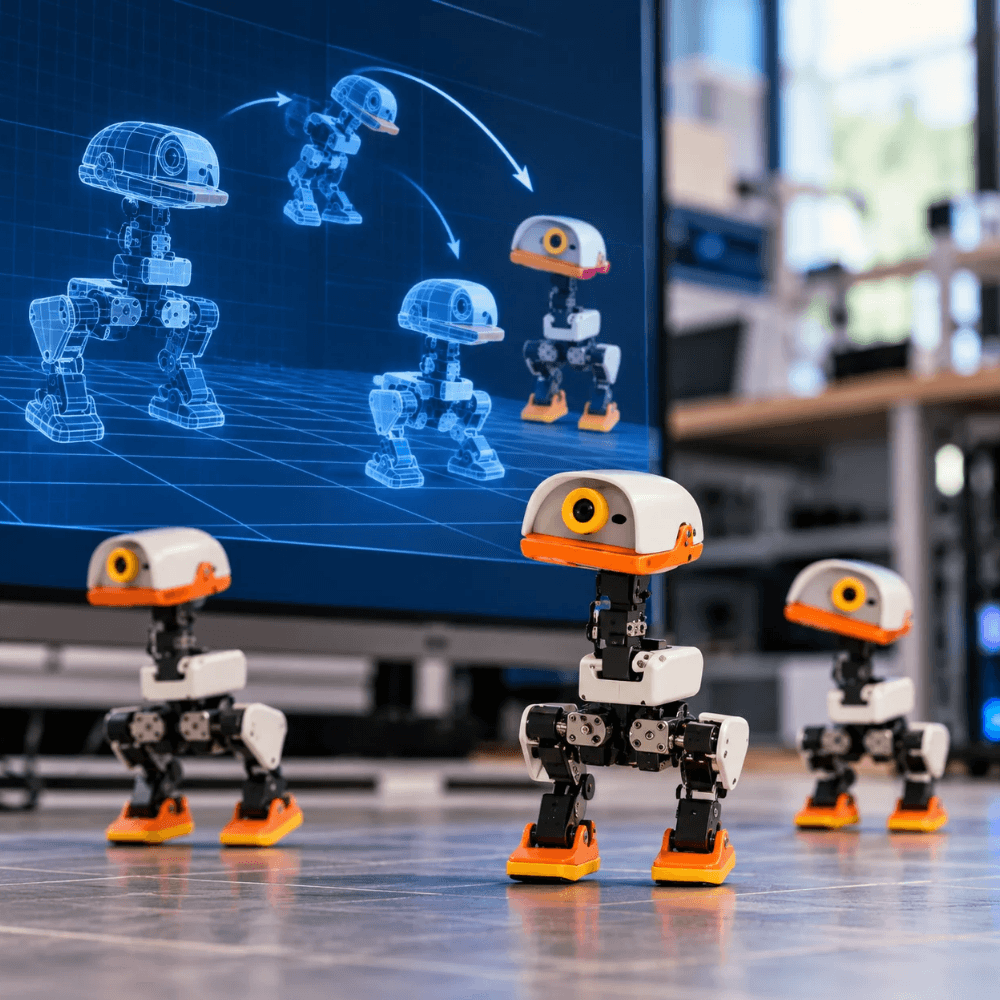
MicroDuck is a small, open-source robot. It was developed through work involving Pollen Robotics and Hugging Face, and NVIDIA’s robotics tools are behind how it learns.
That’s all it is, a little robot that learns to move.
What it does
It walks, reacts to commands and attempts different movements. Simple enough.
The clever part is how it gets there. The robot practises in a virtual world first, so it can fail as many times as it needs to without breaking anything. Once it gets better, the skills are moved over to the real robot. That’s the whole trick, and it’s called sim-to-real.
Think of it like a pilot using a flight simulator before ever touching a real plane. Same idea, just with a duck.
It isn’t flawless. What works on a screen can behave differently on an actual floor. Still, it makes teaching robots quicker and cheaper than doing every bit of practice in real life.
Why it’s in the spotlight
AI has spent the last few years getting really good at writing, making images and answering questions. All of that lives on a screen.
Robots like MicroDuck point to the next step, which is AI that does things in the real world. Moving, handling objects, finding its way around. That’s a big shift, and it explains why physical AI is suddenly everywhere in tech news.
There’s more happening around it, too. At the same Berlin event, Germany’s Agile Robots said it plans to build 1,000 to 2,000 smaller humanoid robots in 2027, working with NVIDIA. They’re meant for research, so universities and company labs can get hold of the hardware and start experimenting.
What can be done with it
Right now, mostly learning and experimenting. Since MicroDuck is open source, students, researchers and independent developers can play with it and see what these machines can do. Not only the big companies.
Further out, the same way of training robots could help in places like warehouses and factories, where things keep changing and robots need to cope. Practising in simulation first means fewer surprises later.
For businesses, the takeaway is simple. Robots are getting easier to train, and that tends to lower the barrier for trying them out.
Hype vs reality
A reality check is worth having. A robot that walks isn’t a robot that can do your job. Recognising unfamiliar objects, working safely around people and handling the unexpected are all still hard. Cost, upkeep and safety matter too.
So MicroDuck isn’t proof that humanoids are about to take over. It’s an early sign of where things are heading.
And that’s why a tiny robot duck learning to walk is worth paying attention to. It’s a small experiment, and it’s part of a much bigger story about AI stepping off the screen and into the real world.