November 23, 2026 By: Mahesh CR
A shared explainer for our engineering posts. Read with Six Neurons
What an assistant reads before it answers
When someone in an organisation asks an assistant a question, what does the model actually see?
The question, and a good deal more. A model answers from whatever text is placed in front of it, and in a working system that text is put together, piece by piece, every time someone asks. We call that step context assembly. Most of what goes right or wrong in these systems happens there, before the model has written a word.
Take a question an analyst might ask: “Why did LPG refills fall in June?” By the time it reaches the model, it sits among several other things.
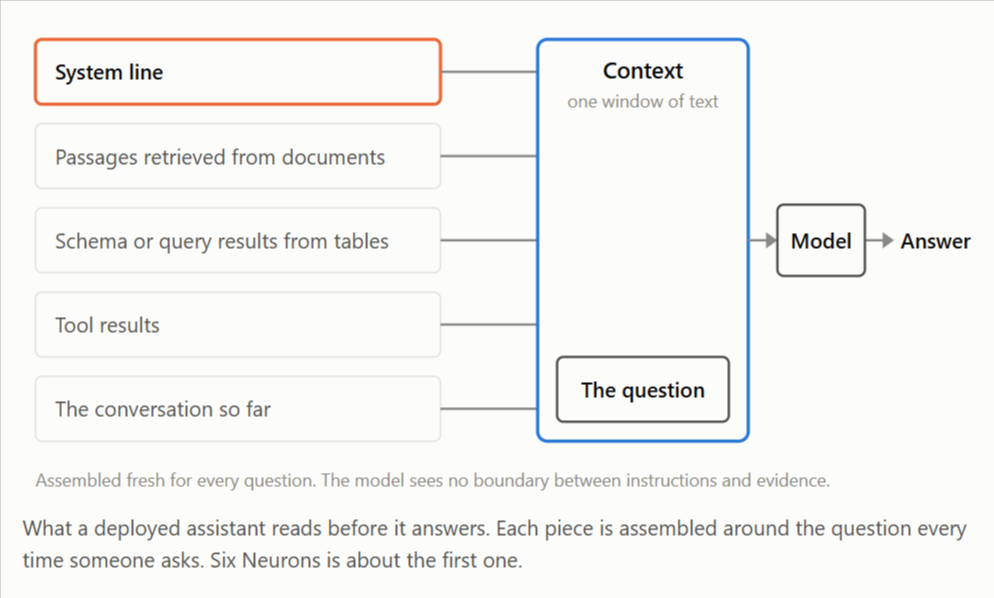 The system line. Standing instructions the deployment writes once and puts before every question: who the assistant is, what it may do, which language to answer in. The user never sees it. In Six Neurons, one sentence of it was enough to make a model answer English questions in Hindi.
Retrieved passages, from documents. Reports, circulars, manuals and emails are split into passages and indexed. The system searches them for passages that look relevant to the question and puts the best few in. This is what people usually mean by retrieval-augmented generation, or RAG. The model can only use what retrieval found, and it cannot tell what was missed.
Data, from tables. Numbers mostly live in databases. For a question like the one above, the system either shows the model the table structure and lets it write a query, or gives it a set of named, pre-defined measures to ask for. The query runs, and the rows come back into the context. Here the failure that matters is a query that runs, returns a sensible-looking table, and is wrong.
Tool results. An agent is a model that is allowed to call tools in a loop: run a query, look something up, do a calculation, read the result, decide what to do next. Each result is added to the context for the next step. Over several steps the context grows, and early mistakes are carried forward.
The conversation so far. Earlier questions and answers, so that “and in July?” makes sense.
Everything above competes for a limited space, and the model weighs all of it together. It has no separate channel for “instructions” and “evidence”. A system line, a retrieved passage and a table header are all just text in the same window, which is why a word in one of them can change what the model does with another.
Each of our posts looks at one part of this picture. Six Neurons is about the system line. The posts on Hindi questions over data, on silent wrong answers and on explaining anomalies are about the data path. The post on thinking settings is about agents and their tools.