
November 23, 2026 By: Mahesh CR
Fixing a language fault in NVIDIA’s Nemotron Nano by editing its weights directly
Why would a model that writes good Hindi answer an English question in Hindi? And if the fault sits somewhere in the weights, could you find the spot and fix it, the way you fix a bug in code?
A great many people in India write in Hindi and English, often in the same hour. An assistant that answers them in the wrong language is of no use, however good the answer. So when we tested NVIDIA’s Nemotron 3 Nano 4B, a small open model we would happily run on modest hardware, the first thing we checked was whether it answers in the language it is asked in.
Without any instructions, it does. English questions get English answers, nearly every time, and Hindi questions get Hindi. Then we gave it a system line of the kind every deployment carries: “Answer in the language of the question: a Hindi question gets a Hindi answer, an English question an English answer.” With thinking switched off, it answered about half of our English test questions in Hindi. The system line is one part of what a deployed assistant reads before it answers, the standing instructions the user never sees; this post is about that part.
Here is one. We asked, “What are Umbilical Cord Knots?” It replied, “उम्बिलिक कोर्ड कट्स क्या हैं?” That is our question, transliterated into Hindi, with a question mark. No answer at all.
Why this is hard to fix
The usual remedy is fine-tuning. You collect examples of the behaviour you want and train the model on them. It works, but you change millions of numbers you cannot read, and the change reaches places you did not mean to touch. You find out what broke later, if you find out.
A recent post from MIT CSAIL, Sparks of Weight-Space Programming (Takehi, Teoh, Zhang and Khattab), tried something else. Give a frontier model the weights of a small model inside a Python session. Let it read them, run the small model on a limited number of prompts, and change the weights itself, with no gradients and no training loop. On one small model it removed a reasoning fault by editing 0.016% of the weights. On another it failed, and the authors say why: editing can remove an obstacle that hides an ability, but it cannot add an ability that is missing.
Our fault looked like the first kind. Nano can write English. Something was stopping it.
What we weighed before starting
This is not the fault we came looking for. Our agent tests had shown Nano answering some Hindi questions in English, and that was the fault we meant to fix. The first measurement seemed to agree: with no instructions, 13 to 16% of the Hindi prompts got English answers. Then we read the prompts. 27 of the 200 in the Hindi set we had held out were written in English. Scored by the script each question was actually written in, the model answered Hindi in Hindi 97% of the time. The fault we came for was mostly in our labels. The same measurements showed the real one, in the runs with the system line.
My own first guess came from how I picture these models. A model learns the patterns of each language, and those patterns line up across languages, the way king and queen sit like father and mother in Hindi as in English. Somewhere along the way it settles which language to answer in, and every layer after that can keep the choice or drift from it. Nothing marks that early choice as one the later layers must hold, and Hindi is the adjacent lane, close by and easy to slip into. So I expected the choice to be made right and then lost, somewhere downstream.
Three choices shaped everything after that.
Which model. NVIDIA’s Nano comes in a 4B and a 30B. We started with the 4B. One GPU holds it, an editable copy of its weights and a serving engine, and a session costs little, so it was the cheap place to learn whether the method works at all. The cost of that choice is that a result on 4B says nothing yet about 30B.
Whether this fault suits the method. The MIT post’s failure told us what to look for: a fault that hides an ability the model already has. A language mix-up looked like one, since Nano writes both languages well. We had two other faults ready in case the measurements disagreed: tool calls going wrong with thinking off, and a data-sensitivity check that put some restricted items in a lower level.
Who does the editing. We could have done the interpretability work ourselves, layer by layer, and written the edit by hand. We let a frontier model do it, under the same rules as the MIT post, with the same three budgets. What we wanted to know was whether the MIT method carries over to another model and another fault, so we kept to it.
One more decision was made before any edit: every edit would be compared with an ordinary fine-tune on the same practice data, because that is the first question anyone would ask.
The setup
We used OpenAI’s GPT-6.2 Astra as the editor. It got the weights of Nano 4B in a Python session on one GPU, 700 practice prompts from the public Aya dataset in English and Hindi, and a small budget of runs. Reading and changing the weights was free. Training was blocked. More on how the editor worked.
We scored every edit on prompts the editor never saw: held-out Aya prompts, our own English and Hindi data questions, and three wordings of the language rule it was never shown. More on how we measured.
To keep this readable I am simplifying the editor’s mathematics, and leaving out most of its dead ends. The full transcripts run to dozens of turns each.
Finding the place
How do you find where in four billion numbers a habit lives?
The editor ran the model four ways, with the rule and without it, on English questions and on Hindi ones, and compared the internal states layer by layer.
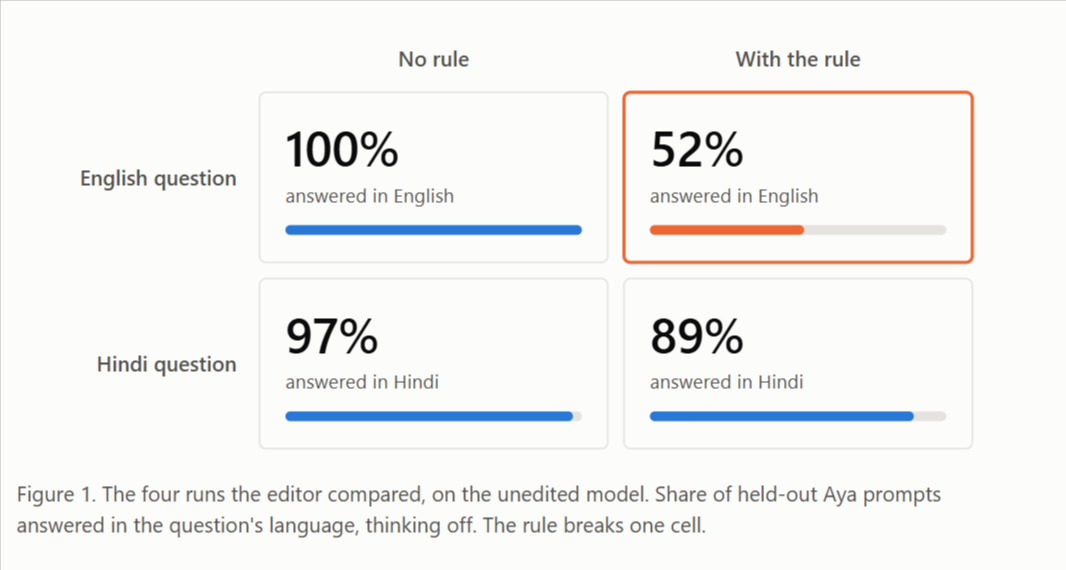
At layer 25, at the exact point where the answer begins, the model’s internal state still separated English questions from Hindi ones, even in the cases where it went on to answer in the wrong language. The model knew what language it had been asked in. We had not expected that. Somewhere after that point, the rule was winning. It was close to the guess I had started with.
Three budgets, three edits
We ran the editor three times, with budgets of 10, 25 and 50 units. Each time it found something different.
With 50 units it found the narrowest cause. Most of the fault came from the word “Hindi” itself, the two times it appears in the rule. Swap that word for a neutral one and the fault mostly went away. The editor rewrote a single neuron in layer 5 so that those two mentions stopped pulling the answer towards Hindi. On the exact rule it was shown, English questions answered in English went from 52% to 100%.
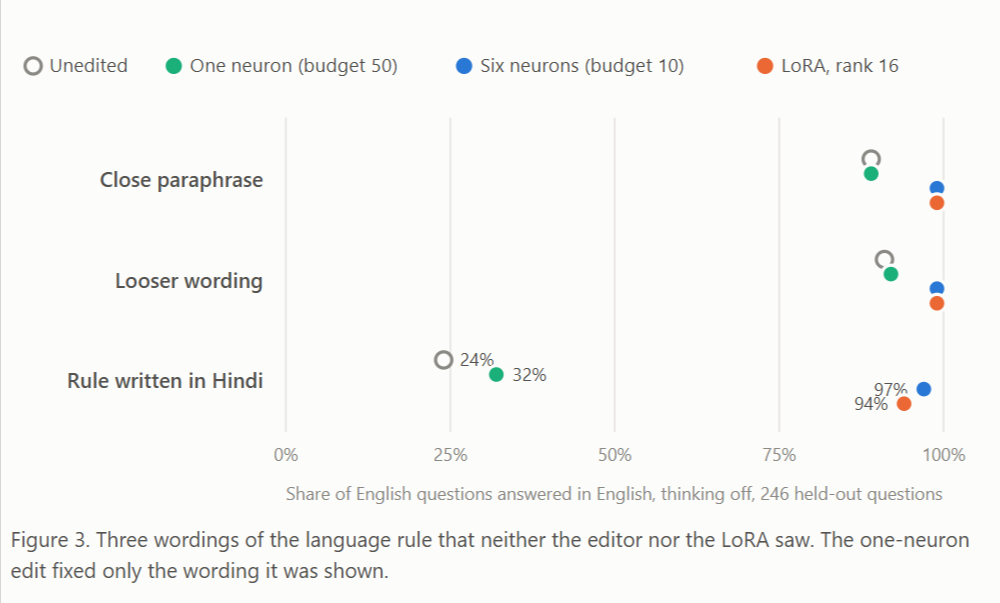
Then we tried the same edit with rules it had not seen. It did nothing. Reworded slightly, or written in Hindi, the rule broke the model just as before.
With 10 units, the smallest budget, it built something more general. It replaced six neurons in layer 25 with two small gates of three neurons each. One gate fires when there is a language rule and the question is English, and pushes the answer back towards English. The other nudges Hindi questions towards Hindi when there is no rule at all. Each gate’s push levels off past a point, instead of growing with the strength of whatever triggered it.
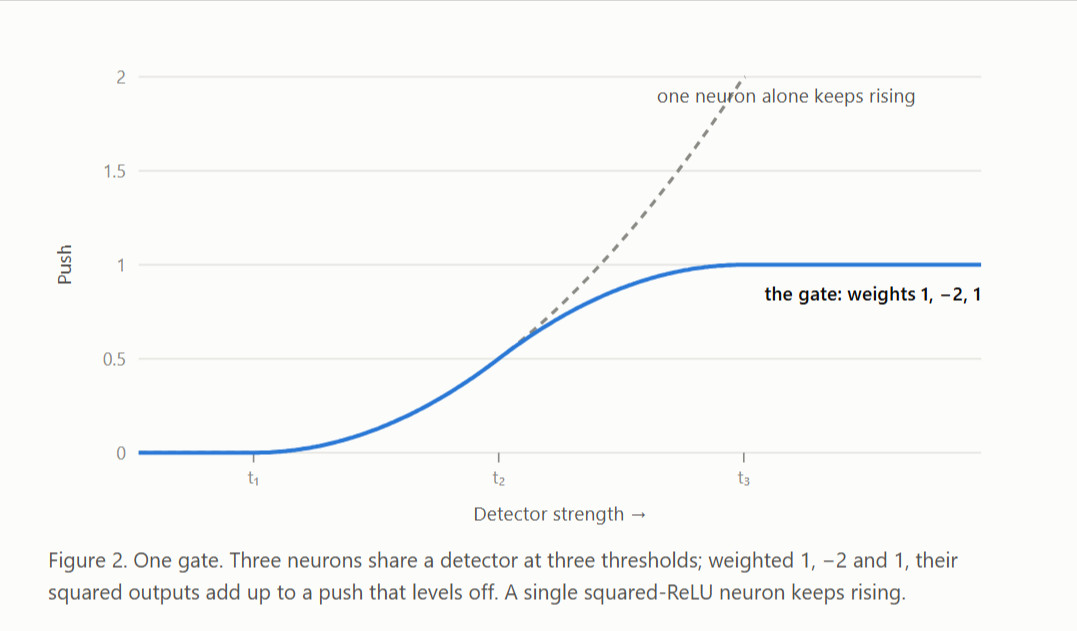
That is 37,619 numbers out of four billion, 0.0009% of the model. On held-out prompts with the rule, English answered in English went from 52% to 98%. On our own English data questions it went from 73% to 100%. Hindi questions answered in Hindi went from 89% to 96%.
And this one carried over. On the three rules it had never seen, English stayed English 97 to 99% of the time. The hardest was the rule written in Hindi. Without the edit the model answered English questions in Hindi three times out of four under that rule; with the edit, 3% of the time.
The umbilical cord question now gets this: “Umbilical cord knots are a condition where the umbilical cord is twisted or knotted around the baby’s neck or body during birth.”
Is this just fine-tuning by hand?
That was our question too, so we fine-tuned the same model to fix the same fault. A standard LoRA fine-tune, rank 16, trained on the same 700 practice prompts, with the unedited model’s own answers (given without the rule) as the targets.
On the target it did as well as the edit, a little better on some sets. It also carried over to the unseen rules.
Merged, it had changed 1.35 billion weights, a third of the model. Hindi answers to ordinary prompts, where nothing had been wrong, got worse: a judge model preferred the original answers 79 times to 43. With thinking switched on, accuracy on our text-to-SQL questions fell from 61 to 51 out of 100. We trained only on thinking-off answers, and that is probably why.
What it cost
The six-neuron edit is not free either. On our text-to-SQL questions, which carry a long system prompt that itself mentions Hindi, the gate fires and nudges the SQL. With thinking off the model got four questions wrong that it used to get right, and none right that it used to get wrong. With thinking on there was no difference.
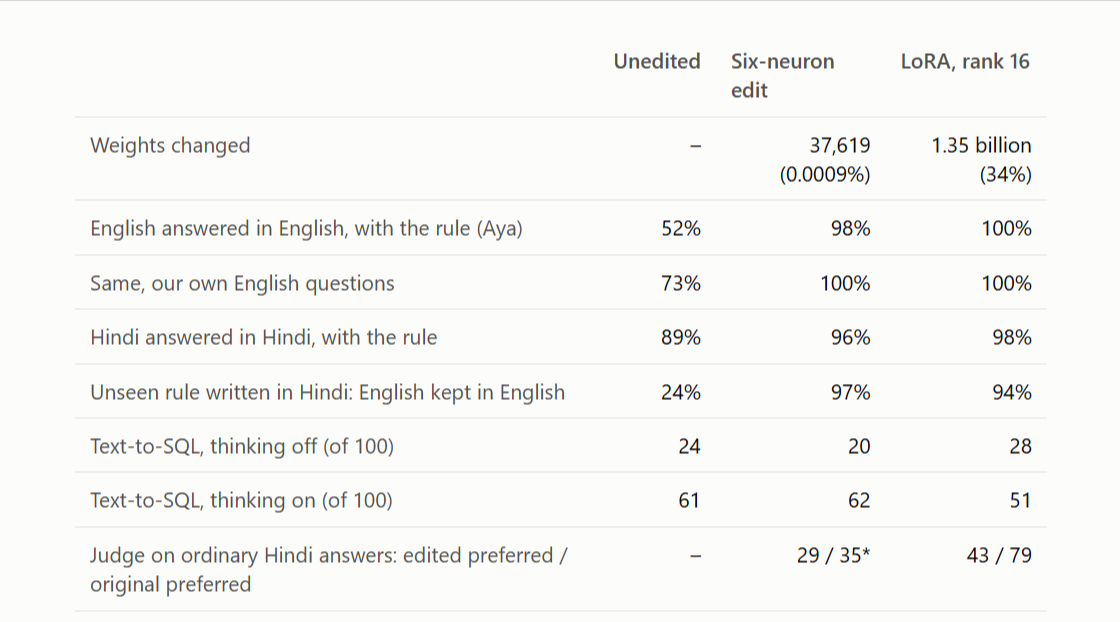
Figure 4. The unedited model, the six-neuron edit and the LoRA on the same held-out sets. Thinking off unless stated. *Within run-to-run noise; see how we measured.
What we are not claiming: this is one model, one fault and one small set of tests, and one run at each budget. Small differences in answer quality mean little, because the unedited model does not repeat itself exactly from one run to the next.
Where this sits
If you follow mechanistic interpretability, much of this will look familiar. That field tries to read a network’s computation out of its weights and activations in pieces small enough to name: this neuron responds to that, this attention head copies from there. Part of it goes on to edit. Meng and colleagues traced where GPT stored a fact, such as the city a landmark is in, and changed it with a single update to one MLP layer.
The editor’s first moves were the interpretability workflow. It ran prompts that differ in one thing, looked for where the internal states part ways, and swapped one word to test a guess. The finding about the word “Hindi” is the kind of result those papers report. So is the finding that layer 25 still carried the question’s language. Anthropic’s researchers, tracing how Claude handles several languages, found much of the middle of the model shared across languages, with the language itself tracked separately and applied near the output. Our model looked similar from the outside: it knew the language, and something later overrode it.
Two things were different here. Nobody on our side did the analysis; we read it afterwards in the transcript. And the editor wrote new mechanism into the model, two gates small enough that their working can be read from six rows and six columns of numbers. We have not yet checked its account with the usual interpretability tests, such as copying the gate’s output into runs where it should stay silent and seeing what changes.
Where this leaves us
A language fault in a small open model could be found at one layer and fixed by replacing six neurons, with ten small batches of runs and no training. The fix carried over to wordings of the rule it had never seen, including one in Hindi. It cost four text-to-SQL questions with thinking off. The LoRA fixed the same fault and moved a third of the model to do it.
The smallest budget gave the most general edit. That may be the luck of three single runs. We would want several runs at each budget before reading anything into it.
The edit is a file of 37,619 numbers. It can sit beside the model, be applied when the model loads, and be taken off again. Our next tests are the interpretability checks above, several runs per budget, and a larger Nemotron.
The six neurons are rows 190, 11969, 33, 12320, 133 and 618 of layer 25.
References
1. Takehi, Teoh, Zhang, Khattab. Sparks of Weight-Space Programming. MIT CSAIL, November 2026. https://rikiyat.github.io/blog/weight-space-programming/
2. NVIDIA. NVIDIA-Nemotron-3-Nano-4B-BF16 model card, Hugging Face. https://huggingface.co/nvidia/NVIDIA-Nemotron-3-Nano-4B-BF16
3. Singh et al. Aya Dataset: An Open-Access Collection for Multilingual Instruction Tuning. 2024. https://arxiv.org/abs/2402.06619
4. Hu et al. LoRA: Low-Rank Adaptation of Large Language Models. 2021. https://arxiv.org/abs/2106.09685
5. Meng, Bau, Andonian, Belinkov. Locating and Editing Factual Associations in GPT. NeurIPS 2022. https://arxiv.org/abs/2202.05262
6. Geva, Schuster, Berant, Levy. Transformer Feed-Forward Layers Are Key-Value Memories. EMNLP 2021. https://arxiv.org/abs/2012.14913
7. Olah et al. Zoom In: An Introduction to Circuits. Distill, 2020. https://distill.pub/2020/circuits/zoom-in/
8. Wang, Variengien, Conmy, Shlegeris, Steinhardt. Interpretability in the Wild: a Circuit for Indirect Object Identification in GPT-2 Small. ICLR 2023. https://arxiv.org/abs/2211.00593
9. Lindsey et al. On the Biology of a Large Language Model. Anthropic, 2025. https://transformer-circuits.pub/2025/attribution-graphs/biology.html
Explainers
- What an Assistant Reads Before It Answers
- How the Editor Worked
- What Rewriting a Neuron Means
- LoRA and Why It Touched a Third of the Model
- How We Measured