November 23, 2026 By: Mahesh CR
An explainer for Six Neurons
How the editor worked
What exactly could the editing model do, and what stopped it from cheating?
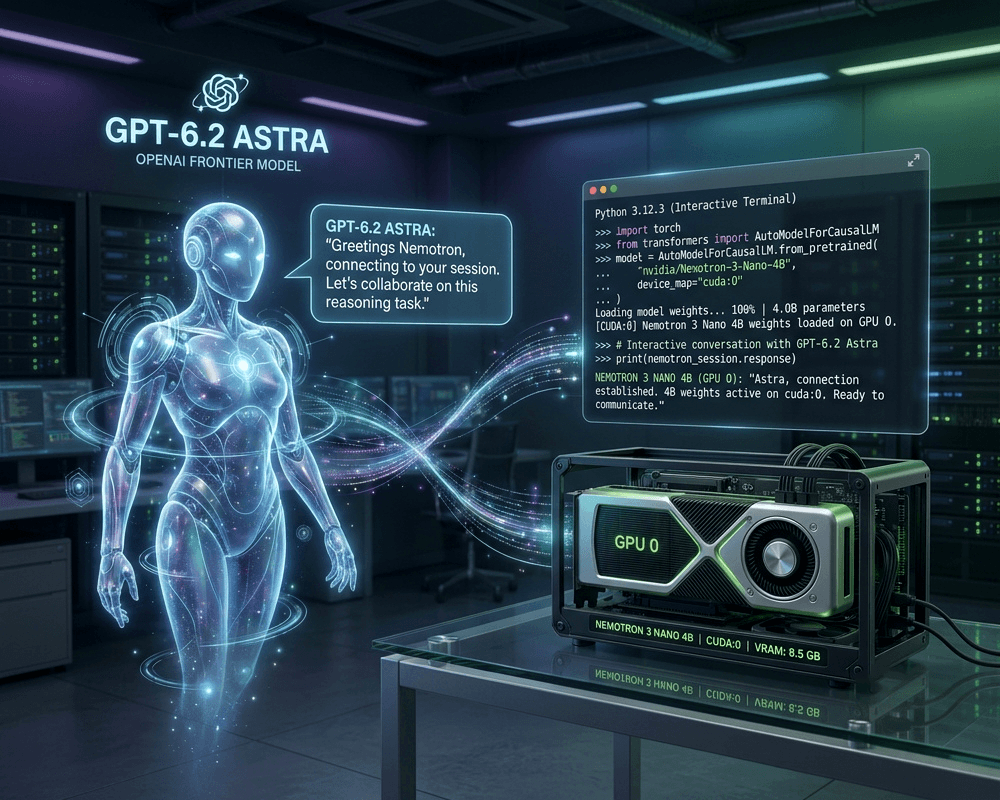
The editor was GPT-6.2 Astra, talking to a Python session that held Nemotron 3 Nano 4B’s weights on one GPU. It had four tools.
1. Run Python. Read any weight tensor, do arithmetic on it, write it back. This was free.
2. Generate. Run the model on up to 64 practice prompts and read the answers. One unit of budget.
3. Look inside. Record the model’s internal activations, layer by layer, on up to 128 texts. One unit of budget.
4. Save the edit. Write the changed weights as a difference against the original, with a note on what was done.
A budget of 10 units meant ten of those batches in the whole session. The editor spent them on finding the fault, testing ideas and checking its edit. Everything else, the reading and the arithmetic, it did on the weights themselves.
What was blocked. Gradients and training. Autograd was switched off, and any code that mentioned backward passes, optimisers or gradient tracking was refused before it ran. So the editor could not quietly run a fine-tune inside the session. Every change had to be one it computed and could describe.
What it could see. Only the 700 practice prompts, from the public Aya dataset in English and Hindi. The prompts we scored on were held out, and the session refused to generate on them even if asked by id.
What it gave back. The changed weights, a short account of the edit in its own words, and the full transcript. For the six-neuron session that was 26 turns. Its account of the gate runs to one dense paragraph: which rows it replaced, how it built the detectors from averages of the model’s activations, and why it combined three neurons in each gate. The post simplifies that paragraph; What Rewriting a Neuron Means goes one level deeper.
How edits reached the model. The session kept two copies: one the editor could change, and a serving copy that ran the prompts. After each change the edited tensors were pushed into the serving copy, so every batch of prompts ran on the current edit at normal serving speed.
We ran three sessions, with budgets of 10, 25 and 50 units, one run each.