
November 23, 2026 By: Mahesh CR
An explainer for Six Neurons
What rewriting a neuron means
When we say the editor replaced six neurons, what changed, physically, in the file?
Nemotron 3 Nano 4B is a stack of layers of three kinds: Mamba layers, attention layers and MLP layers. Each word position carries a vector of 3,136 numbers up the stack, and each layer reads that vector and adds something back to it. The edit was in one MLP layer, layer 25.
Layer 25’s MLP has 12,544 neurons. Each neuron is two pieces of weights:
- an input row, 3,136 numbers. The neuron takes the dot product of this row with the incoming vector. That is how strongly it responds.
- an output column, also 3,136 numbers. The response, after passing through the layer’s activation, scales this column, and the result is added back into the vector.
So a neuron is a detector and a push. The row decides what it responds to; the column decides which way it pushes. Geva and colleagues described MLP neurons this way, as keys and values, and it is a fair picture for this edit. Replacing six neurons means overwriting six rows and six columns. Six times roughly 6,270 numbers gives the 37,619 weights in the post.
Which neurons. The editor picked six neurons in layer 25 that contributed little to the model’s output on its practice prompts, and overwrote them. Their old jobs were small enough to give up.
The detectors. For each condition it cared about, such as “a language rule is present and the question is English”, the editor computed a direction from the model’s own activations: the average state in that condition, adjusted so that it ignored ordinary words and explicit requests to answer in a given language. That direction became the input row.
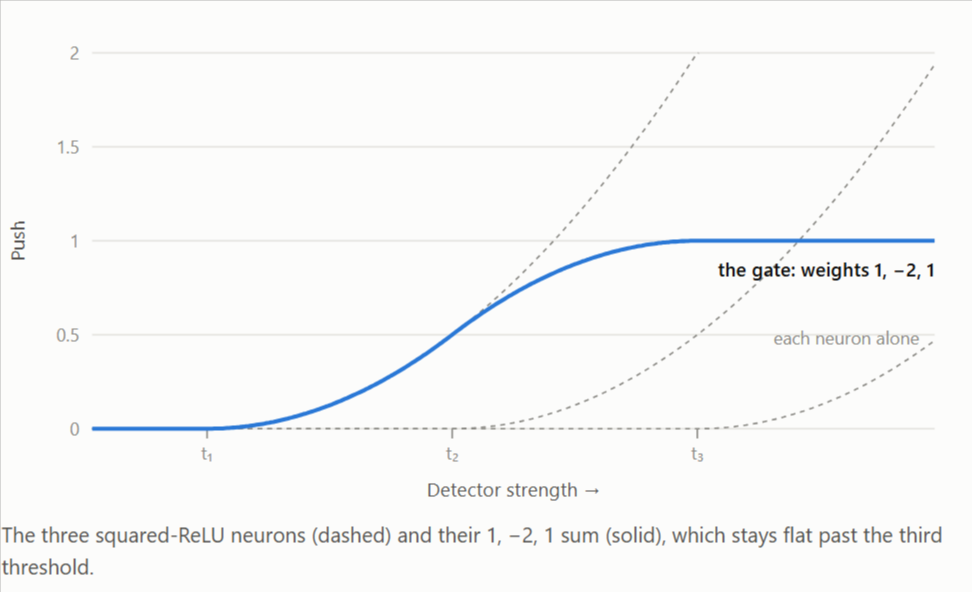
Why three neurons per gate. Nano’s MLP uses a squared ReLU: a neuron’s output is zero below its threshold and grows as the square above it. One neuron alone would push harder and harder the more strongly it fired, which is how you get an edit that overshoots. The editor gave three neurons the same detector at three thresholds, evenly spaced, and combined their outputs with weights 1, −2 and 1. Past the third threshold the squares cancel out to a constant. The push rises, then stays flat at the size the editor chose.
 What each gate pushes. One gate, firing on “rule present, English question”, pushes the state towards where it would be with no rule, and away from the Hindi-output direction. The other, firing on “no rule, Hindi question”, pushes gently towards Hindi. The other two cases get no push.
The six neurons are rows 190, 11969, 33, 12320, 133 and 618 of layer 25’s MLP.